The lawsuit by Kings County et.al. was a significant threat to California's $64 billion rail plan, based on the plan's ability to meet the terms promised in the 2008 proposition, such as travel time due to sharing tracks with Caltrain.


The California High-Speed Rail Authority's relief was displayed by a "breaking news" notice on its homepage on Tuesday, March 8: "Today's ruling confirms that we are indeed delivering a fast, modern and environmentally-friendly high-speed rail system that meets the voter-approved requirements under Proposition 1A."
On Feb. 11 in Sacramento County Superior Court, "attorneys for Kings County and two Central Valley farmers argued that the California bullet train project violates state law because it is not financially viable, will operate slower than promised and has compromised its design by using existing shared tracks in the Bay Area," wrote Ralph Vartabedian and Marc Vartabedian for the Los Angeles Times earlier.
"The ruling [PDF] by Sacramento County Superior Court Judge Michael Kenny is a blow to efforts to stop the project and boosts California’s $64 billion plan to develop a system of high-speed electric trains to ultimately connect Los Angeles and San Francisco...," writes Tim Sheehan for The Fresno Bee. "But Kenny’s ruling could still be appealed to a state appellate court."
However, all is not copacetic for the High-Speed Rail Authority, as the plaintiffs' attorney noted. In short, the authority can't tap the majority of the $9.95 billion, 2008 bond measure.
“Though the high-speed rail authority may have won this round, the ruling … provides ominous signs about the Authority’s future use of bond funds,” said Oakland attorney Stuart Flashman. “It notes that while the court considers it premature to find the system non-compliant, in its present stance it does not appear that use of bond funds would be permissible.”
See Flashman make his case to The Fresno Bee on Feb. 11 in this video, along with a response from Authority spokesperson Lisa Marie Alley.
The authority has been "relying on about $3 billion in federal transportation and stimulus funds as well as cap-and-trade money from the state’s greenhouse gas-reduction program," writes Sheehan. "[Judge Kenny] added that until the rail authority submits a new financing plan that meets the bond act’s requirements, none of [the bond funds] can be used for construction."
Sheehan lists the opponents' points which they believe violate Prop 1A, which were dismissed, though not entirely, by Judge Kenny:
- "That a proposed “blended” system in which high-speed trains would share upgraded and electrified tracks with the Caltrain commuter rail line between San Jose and San Francisco is inconsistent with what voters approved in the ballot measure."
'It appears at this time that the authority does not have sufficient evidence to prove the blended system can currently comply with all of the Bond Act requirements,” Kenny wrote. However, he added, "the authority may be able to accomplish these objectives at some point in the future. This is an ongoing, dynamic, changing project."
- "That the proposed route would be unable to meet Prop. 1A’s requirement to provide a nonstop, 2-hour 40-minute ride between San Francisco and Los Angeles...
- "That the system would not be financially viable and could not be realistically expected to meet the law’s mandate to cover its operating costs without any subsidy of public funds."
Hat tip to Darrell Clarke, transit advocate.
FULL STORY: In major win for high-speed rail, judge rejects claims by Kings County foes of bullet train

California High Speed Rail Authority Denied Request to Overturn Lawsuit
Seems like it's nothing but bad news for the rail authority since a judge ruled in November that the project was not in compliance with the proposition that the voters approved in 2008. This appeals court ruling means that a trial will move forward.
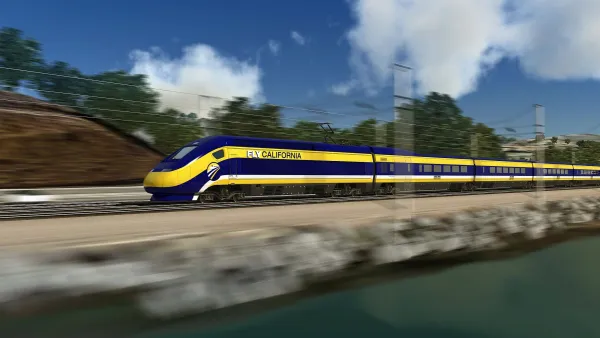
Major Court Victory for California High-Speed Rail Authority
Plaintiffs suing the state of California over a 2016 law that allowed the High-Speed Rail Authority to tap a $9.9 billion bond measure, passed by voters a decade ago to pay for construction on "usable segments," came up short for the second time.
The California High-Speed Rail Authority's Board Took a 'Momentous' Step on Tuesday
The California High-Speed Rail Authority voted on December 13 to approve two plans that would spend $3.2 billion in high-speed rail bond funds for continuing construction in the Central Valley and help pay for Caltrain commuter rail electrification.

The state-sanctioned urbicide of Austin
People don’t kill cities. Freeways do.

US to reduce Colorado River water deliveries to Mexico
A new Colorado Treaty amendment reduces Mexico’s Colorado River water allocation by 250,000 acre feet.

New Jersey’s second-largest city bans standalone data centers
Jersey City will continue to allow co-location facilities, such as those meant for research institutions that store their own data.

Amtrak not solely to blame for New Jersey commuter rail's unreliability, report finds
A new study from the Garden State Initiative found that NJ Transit’s budget grew 20% across a 4 year period, but reliability declined significantly over the same period.

EPA erases limits on planet-warming pollution from power plants
Under Monday’s plan, power plants would still have some limits on how much mercury, arsenic and other contaminants they can emit.

Phoenix announces new on-demand transit service, more frequent RAPID buses
Both new services will launch in October, and are part of Phoenix's Project Effective Access Solutions for Easing Congestion.

FREE Course: Walkable City 1: Why Walkability?
After describing his path towards focusing on walkability as the essence of good planning, Jeff Speck marches through his five principal reasons for making more walkable places.
Reinventing Malls: Planning Alchemy—Turning Gray Fields Into Gold
The course focuses on the opportunities and imperatives that shape reinvention of mall sites.

Eagle County Government
Harvard University Graduate School of Design
Nashville Planning Department
The Architects Foundation
University of Cincinnati Online
The Pocatello Development Authority
The Urban Renewal Agency of the City of Pocatello
Journal of the American Planning Association