The Lincoln Institute of Land Policy has released its annual comparison of property tax rates around the country, adding new wrinkles of analysis for this year's edition.



"The Lincoln Institute of Land Policy has released the latest edition of its annual report on property tax rates in all 50 U.S. states, with a new analysis of how communities raise revenue to pay for basic public services," according to an article on the At Lincoln House blog.
The Lincoln Institute partnered with the Minnesota Center for Fiscal Excellence on the "50-State Property Tax Comparison Study" to track the effective tax rate for residential, commercial, industrial, and apartment properties in more than 100 U.S. cities. Planetizen also picked up news of the previous reports, released in 2015 and 2014.
The blog post explains the analysis included in this year's report, such as a comparison of tax rates between cities, "exploring factors such as the reliance on property taxes relative other revenues such as the sales tax; the variation in property values; the differential treatment of residential and commercial property; and the level of local government spending."
For those keeping track at home, Bridgeport, Connecticut tops the list again for the highest property tax in the nation, just as it did the previous two years. This year's edition of the report also explains why its property tax rate has reached 3.88 percent of median home value: "high property tax reliance." Compare that to the cause of the second city on the list, Detroit, which has achieved a 3.81 percent property tax rate due to "low property values."
Read the full story: Lincoln Institute Releases New Analysis of Property Taxes in 50 States

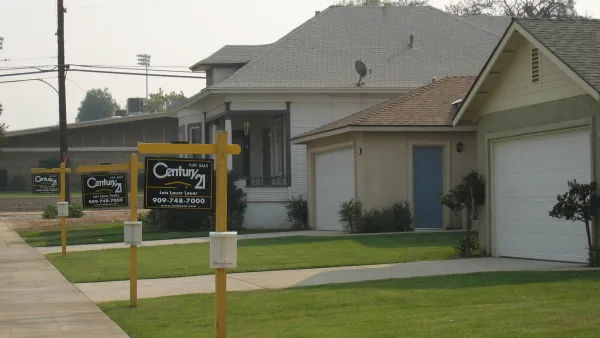
Reports Surveys Property Tax Burdens in all 50 States
The annual "50-State Property Tax Comparison Study" offers a thorough resource for understanding the role of property taxes in fiscal responsibility at the municipal level.
Report Compares Property Taxes Around the Country
Calling the property tax, "probably the most controversial tax in the United States," the Lincoln Institute of Land Policy and the Minnesota Center for Fiscal Excellence have released the "50-State Property Tax Comparison Study" for 2013.

Comparing the Differences in Property Taxes Around the United States
The Lincoln Institute of Land Policy and the Minnesota Center for Fiscal Excellence have released their annual "50-State Property Tax Comparison Study."

Planetizen Federal Action Tracker
A weekly monitor of how Trump’s orders and actions are impacting planners and planning in America.

Data reveals that NYC’s bet on congestion pricing has paid off
After almost two years of the program, reports show positive impacts on traffic and air quality and no disruptions to parking.

HUD modernizes 50-year-old manufactured housing framework
The Next Generation Manufactured Housing Action Plan establishes new energy-efficiency standards for manufactured homes, and new guidelines for anchoring them.

California voters weigh $11.25 billion housing bond
Prop. 1, combined with other funding, would support over 40,000 new rental units in California.

Connecticut is turning landfills into green infrastructure
Twenty-nine solar arrays have been built, or approved to be built, on top of Connecticut landfills.

Trump guts ‘win-win’ solar energy program for rural farmers
The U.S. Department of Agriculture’s changes have made virtually all solar power ineligible for funding through the Rural Energy for America Program.

FREE Course: Walkable City 1: Why Walkability?
After describing his path towards focusing on walkability as the essence of good planning, Jeff Speck marches through his five principal reasons for making more walkable places.
Reinventing Malls: Planning Alchemy—Turning Gray Fields Into Gold
The course focuses on the opportunities and imperatives that shape reinvention of mall sites.

One Hundred Miles
County of Mendocino
planning NEXT
The Architects Foundation
University of Cincinnati Online
Montrose County
Northern Illinois Transit Authority (NITA)
The Pocatello Development Authority