Calling the property tax, "probably the most controversial tax in the United States," the Lincoln Institute of Land Policy and the Minnesota Center for Fiscal Excellence have released the "50-State Property Tax Comparison Study" for 2013.


The Lincoln Institute of Land Policy has released its "50-State Property Tax Comparison Study" in partnership with the Minnesota Center for Fiscal Excellence. The goal of the study, according to the Lincoln Institute's website, is to provide accurate data as a foundation for "sound governmental decision-making."
The study examines "effective property tax rates," defined as the actual tax payment as a percentage of market value. As quoted from a press release announcing the report, here are a few of the key points that exemplify the wide variations in property tax policy around the country:
- "Bridgeport, Connecticut continues to impose the highest taxes on median-value homes in urban cities, with an effective rate above 4 percent.
- "The lowest rate, in Columbia, South Carolina, is slightly above .6 percent."
- "The decline in real values in Detroit leaves it with high effective tax rates, but a new revaluation initiative in the city may reduce that rate in the future."
- "The New England region, with its heavy reliance on property taxes, has the highest effective homestead rates, but the Midwest leads with the highest effective rates on commercial property."
- "There was no change between 2012 and 2013 in the top 5 cities with the highest property tax bills on a median-value home."
Read the full story: 50-State Property Tax Comparison Study


Comparing Property Tax Rates for 100 U.S. Cities
The Lincoln Institute of Land Policy has released its annual comparison of property tax rates around the country, adding new wrinkles of analysis for this year's edition.
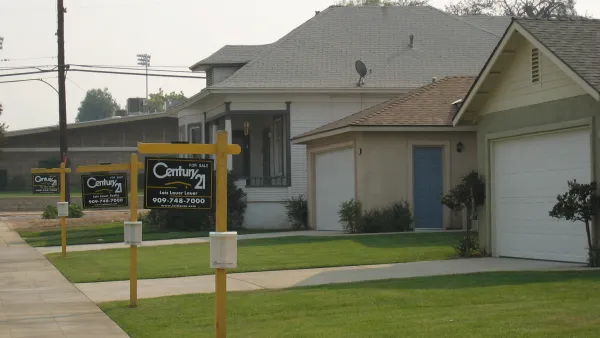
Reports Surveys Property Tax Burdens in all 50 States
The annual "50-State Property Tax Comparison Study" offers a thorough resource for understanding the role of property taxes in fiscal responsibility at the municipal level.

Comparing the Differences in Property Taxes Around the United States
The Lincoln Institute of Land Policy and the Minnesota Center for Fiscal Excellence have released their annual "50-State Property Tax Comparison Study."

Planetizen Federal Action Tracker
A weekly monitor of how Trump’s orders and actions are impacting planners and planning in America.

‘Going backwards:’ Baltimore mayor, students rally against state's transit funding plan
Maryland's proposed six-year plan provides no funding for Baltimore’s BMORE bus program and reduces its road maintenance funding.

Detroit to transform waterfront with $2.2 billion investment
Developers will convert about 18 acres of unused parking lot space into civic spaces.

85-year-old ranch is Texas’ newest state park
The 650 acre ranch is one of the largest parcels of land along Lake Palestine.

MIT to create AI-powered hub for public transportation companies
Google awarded the project, titled the Public Transit Intelligence Hub, $2.1 million in funding.

A 3D concrete printer may solve Virginia’s housing crisis
The printer is able to build concrete walls much faster than humans, and can do so directly at job sites.

FREE Course: Walkable City 1: Why Walkability?
After describing his path towards focusing on walkability as the essence of good planning, Jeff Speck marches through his five principal reasons for making more walkable places.
Reinventing Malls: Planning Alchemy—Turning Gray Fields Into Gold
The course focuses on the opportunities and imperatives that shape reinvention of mall sites.

City of Thousand Oaks
City of Wisconsin Rapids
Harvard University Graduate School of Design
The Architects Foundation
University of Cincinnati Online
Northern Illinois Transit Authority (NITA)
The Pocatello Development Authority
The Urban Renewal Agency of the City of Pocatello