San Francisco is starting a program to recognize and protect long-standing local businesses based on their community value, not architectural significance.



Perhaps more than other cities, San Francisco is famed for its semi-historic places: local gems and storied gathering spots that contribute to the city's texture and lore, but don't qualify for landmark status. (Green Apple Books is one example featured in the New York Daily News.) Because their buildings don't meet the standards for preservation, locals fear these businesses could be displaced by the tech boom, taking meaningful expressions of the city's character and culture with them.
To address that fear, San Francisco will soon begin awarding grants to some such establishments through a new Legacy Business Preservation Fund. Approved by voters in November 2015, the program will award up to $50,000 each to small businesses at least 30 years old that have "contributed to the neighborhood's history and/or identity." It also offers landlords up to $22,500 a year for entering a 10-year lease with a legacy business.
Writing for the Daily News, Sarah Goodyear looks at San Francisco's program alongside similar efforts still struggling for support in New York, as well as other approaches to supporting small business—noting that major European cities have tended to adopt more creative solutions.
FULL STORY: Malls of America

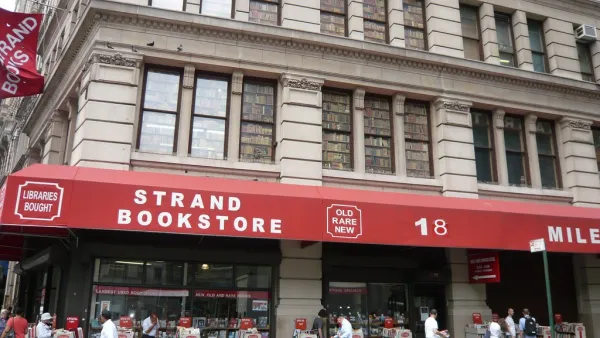
Gentrification Enters Preservation Debate Surrounding NYC's Strand Bookstore
The Renaissance Revival building that houses New York City's beloved Strand Bookstore is under consideration by the city's Landmarks Preservation Commission. The case has provoked debate between rival advocates.

Study Finds More Reasons to Worry About Airbnb's Effect in the Housing Market
The new study, published by the Urban Politics and Governance research group at McGill University, comes with a major disclaimer: it was funded by the Hotel Trades Council, AFL-CIO, among other.

A Bronx Community Fights to Have its Voice Heard
After organizing and giving input for decades, the community around the Kingsbridge Armory might actually see it redeveloped — and they want to continue to have a say in how it goes.

Planetizen Federal Action Tracker
A weekly monitor of how Trump’s orders and actions are impacting planners and planning in America.

The state-sanctioned urbicide of Austin
People don’t kill cities. Freeways do.

US to reduce Colorado River water deliveries to Mexico
A new Colorado Treaty amendment reduces Mexico’s Colorado River water allocation by 250,000 acre feet.

5 New England states march closer to 800 megawatt wind energy project
Securing federal approval for the project may be complicated under the Trump administration, which has historically been hostile towards domestic wind power.

Baltimore to break ground on $50 million Transit Priority Project
The project will bring faster bus trips, safer streets and better bike connections to Baltimore.

Airbnb launches $250 million 'last-dollar financing' housing accelerator, makes first investment in Austin
The company will put $6.4 million towards affordable housing development in Texas’ capital.

FREE Course: Walkable City 1: Why Walkability?
After describing his path towards focusing on walkability as the essence of good planning, Jeff Speck marches through his five principal reasons for making more walkable places.
Reinventing Malls: Planning Alchemy—Turning Gray Fields Into Gold
The course focuses on the opportunities and imperatives that shape reinvention of mall sites.

Eagle County Government
Harvard University Graduate School of Design
Nashville Planning Department
The Architects Foundation
University of Cincinnati Online
The Pocatello Development Authority
The Urban Renewal Agency of the City of Pocatello
Journal of the American Planning Association