Beginning with the first U.S. planned urban development, St. Augustine, Fla., and ending with one of Portland's newest neighborhoods, the Pearl District, host Geoffrey Baer takes us through ten developments that left their mark, for better or worse.


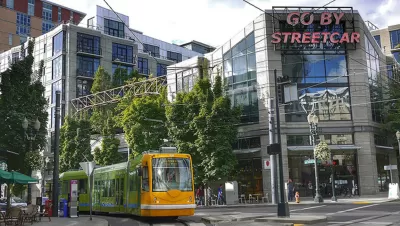
"10 Towns that Changed America focuses on ten 'experimental' towns that did not evolve organically over time, but instead were designed (or redesigned) from the ground up by visionary architects, corporations, and citizens, who sought to change the lives of residents using architecture, design, and urban planning," states the introduction to the PBS special produced by WTTW, Chicago's NPR affiliate.
However, "visionary" does not always produce good results, as some examples show. While (#7) Levittown in Long Island (as well as those in Pennsylvania, New Jersey and Puerto Rico) might have been a boon for new residents fleeing cities, African Americans were excluded, and their legacy in urban planning includes "build(ing) the foundation of suburban sprawl that we have today," writes Erin Chantry in "The Legacy of Levittown."
A better example among the ten examples of well-intentioned urban planning gone awry is (#8) Southwest Washington, DC.
The Southwest DC development approach defined a new concept in planning: "urban renewal." Urban renewal started with a bulldozer and continued with the construction of Modernist towers and "superblocks" dedicated solely to housing, versus the mixed uses of the old neighborhood.
The ten towns, which can be cities, suburbs, or districts, are presented in this order, with links to the description and video provided by WTTW beginning with Philadelphia (PBS takes care of St. Augustine, as well as providing links for a 30-second preview and the 56-minute program).
- St. Augustine, FL WATCH CLIP
- Philadelphia, PA
- Salt Lake City, UT
- Riverside, IL
- Pullman – Chicago, IL
- Greenbelt, MD
- Levittown, NY
- Southwest Washington, D.C.
- Seaside, FL
- Pearl District – Portland, OR
Produced by WTTW, Chicago, the website for "10 Towns that Changed America," that also includes 10 additional towns not shown in the PBS program on April 19.
Read the full story: 10 Towns that Changed America

What's So Special About Oregon and Utah?
These two Western states did something that none of the 20 other states in the nation going the wrong way in the pandemic have yet to do: they paused their reopening plans due to rising coronavirus infections and hospitalizations.

Will Manhattan's "Central Business District Tolling" Clear the Way for More Congestion Pricing?
Cordon pricing applied to Manhattan's Central Business District, approved by the state legislature on March 31 and signed into law by Gov. Andrew Cuomo on April 1, has the ability to be a game changer for other cities considering similar programs.
Gentler Gentrification in Philly's Germantown
Germantown has acquired many more wealthy residents without displacing many of its long-term residents or losing its diversity.

Planetizen Federal Action Tracker
A weekly monitor of how Trump’s orders and actions are impacting planners and planning in America.

California plans to bury El Niño’s downpour
If the state plays its cards right, it may be able to store a billion acre-feet of El Niño’s water in aquifers.

Desperate measures: Advocates weigh draining Lake Powell to fill Colorado River
Draining the reservoir could reduce evaporation losses by a couple hundred thousand acre-feet.

Chicago Avenue bridge construction delays enrages city leaders
The bridge has been closed since 2025. The city originally aimed to re-open it in December, and now expects to finish construction in 2027.

NYC bus network redesign speeds up Queens buses
Rush routes have seen a 4.6% speed increase after the redesign.

California High-Speed Rail Authority picks trainset manufacturer
The California High-Speed Rail Authority aims to start servicing passengers by 2033.

FREE Course: Walkable City 1: Why Walkability?
After describing his path towards focusing on walkability as the essence of good planning, Jeff Speck marches through his five principal reasons for making more walkable places.
Reinventing Malls: Planning Alchemy—Turning Gray Fields Into Gold
The course focuses on the opportunities and imperatives that shape reinvention of mall sites.

City of Rosemead
Rutgers University, Edward J. Bloustein School of Planning and Public Policy
One Hundred Miles
Hunter College, City University of New York (CUNY)
The Architects Foundation
University of Cincinnati Online
City of Cambridge
Montrose County
The Pocatello Development Authority