The projects depicted here re-use and re-appropriate public space, filling gaps in the built environment with parks, open areas, and pedestrian walkways.


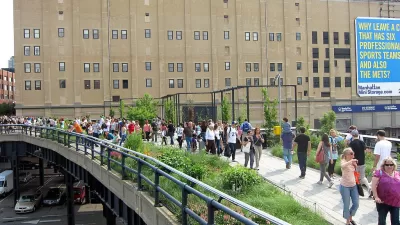
New York's High Line is only one example of the re-appropriation of heavy infrastructure and the spaces it leaves unfilled. This piece lists nine more projects: "What these types of retrofits mean for city dwellers: that any one of them has just as much a right to the use of their city's public space as do the large-scale, heavy-duty applications that previously had exclusive claim to it."
Ross Brady continues, "As for the designs of these new spaces, the evolution of this practice owes a lot to the theoretical emergence of landscape urbanism — that is, that a city should be defined by its open spaces and that its buildings should be understood as structures that simply occur around them." The projects reuse many kinds of spaces, and that reuse doesn't necessarily spell an end to original functions. Examples include:
- Queens Plaza Bicycle and Pedestrian Improvement Project; Long Island City, NY
- Times Square Reconstruction; New York City, NY
- Erie Street Plaza; Milwaukee, WI
- Seattle Art Museum: Olympic Sculpture Park; Seattle, WA
Read the full story: Contested Landscapes: 9 Public Re-Appropriations of Urban Infrastructure
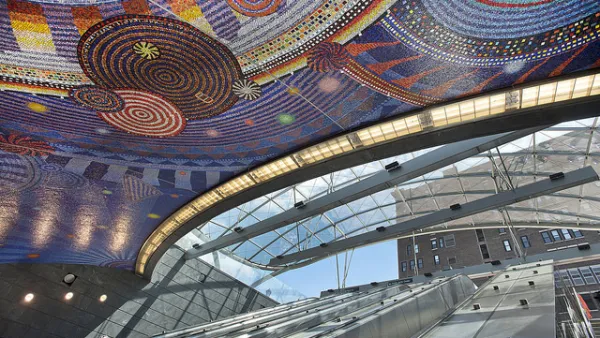
New York's First New Subway Station In 25 Years Opens Sunday
On Sept. 13, the Hudson Yards Subway Station, the new Manhattan terminal for the #7 line that terminates in Flushing, Queens, will open with a grand ribbon-cutting ceremony considering the $2.4 billion cost for the one mile extension.
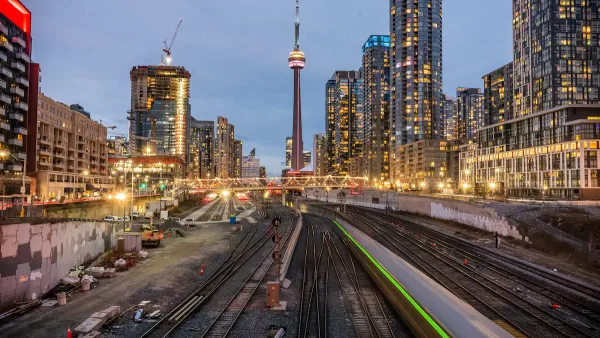
Toronto to Explore Potential High Line-Style Park
City staff will study options for transforming a defunct rail corridor into a linear park.
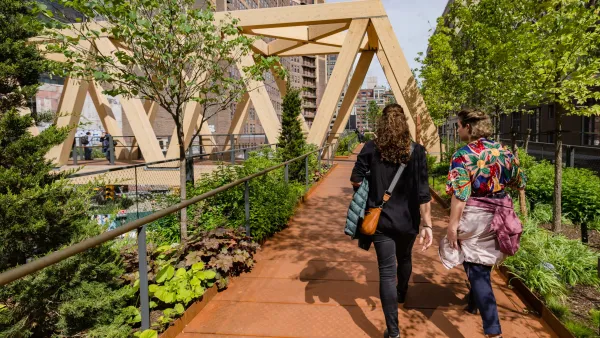
High Line-Moynihan Connector Opens in New York City
Two footbridges now link the High Line park to the most recent expansion of the Penn Station complex, the Moynihan Train Hall.

Planetizen Federal Action Tracker
A weekly monitor of how Trump’s orders and actions are impacting planners and planning in America.

Washington state to charge fee to drivers with fuel-efficient cars
Revenue from the fee will go towards supporting the state’s highways.

Illinois considers spending $1 billion in taxpayer money on data center
A quantum computing campus and data center are currently under construction in Chicago.

Senate passes bill overhauling permitting
The bill still needs to pass the House.

Did data centers change how voters cast their ballots?
Texas, Ohio, and Georgia all flipped party control. But in rural counties, the effect of local data centers was mixed.

Amtrak invests in eight new Airo trainsets
The new trainsets will begin serving passengers in 2031.

FREE Course: Walkable City 1: Why Walkability?
After describing his path towards focusing on walkability as the essence of good planning, Jeff Speck marches through his five principal reasons for making more walkable places.
Reinventing Malls: Planning Alchemy—Turning Gray Fields Into Gold
The course focuses on the opportunities and imperatives that shape reinvention of mall sites.

City of Charlotte
City of Rosemead
Rutgers University, Edward J. Bloustein School of Planning and Public Policy
University of Michigan School for Environment and Sustainability (SEAS)
Hunter College, City University of New York (CUNY)
The Architects Foundation
University District Partnership