A section of the $4 billion World Trade Center Transportation hub, designed by Santiago Calatrava, opened to the public today. The project has already inspired controversy, and will likely continue to do so.


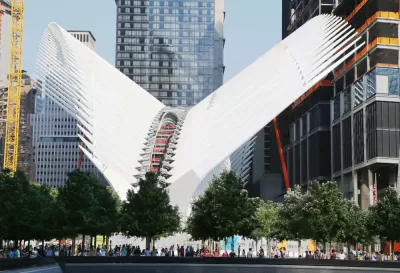
Two of New York's leading design critics produced their reviews for the new World Trade Center Transportation, the day before a section of the building opened to the public. Michael Kimmelman and Paul Goldberger, writing for The New York Times and Vanity Fair, respectively, substantially differed in their opinions.
Headlining Kimmelman's review is the pronouncement of the project as a boondoggle:
The project’s cost soared toward a head-slapping, unconscionable $4 billion in public money for what, in effect, is the 18th-busiest subway stop in New York City, tucked inside a shopping mall, down the block from another shopping center.
Kimmelman does give credit to the Hub's main hall, or Oculus, as a "jaw-dropper" that "can almost — almost — make you forget what an epic boondoggle the whole thing has been." The review references Grand Central Station, speculates on the likelihood of the building achieving the ambitions of the project's supporters, and goes into a lot more detail about the design of the building.
A more optimistic pronouncement headlines Golberger's review: despite the project's cost, Calatrava has produced a "Genuine People's Cathedral." Here's how Goldberger introduces the effect of the new building:
Everyone knows that the World Trade Center Transportation Hub, designed by Santiago Calatrava, was insanely expensive—close to $4 billion at last count—and everyone knows that its design is just a little bit hokey, as if it were assembled out of dinosaur bones that were too big to fit into the Museum of Natural History. What most people don’t know is that if you can get yourself past all of that, and manage to push the dinosaur metaphors and the bird metaphors and all of that money out of your mind, you can have an architectural experience there that may renew your faith in the potential of the public realm in New York.
Golberger focuses in the review on how the project has reversed the course of a half-century of architecturally ambitious public projects, writing, "this is the first time in a half a century that New York City has built a truly sumptuous interior space for the benefit of the public." Goldberger also details the project's antecedents, the most recent of which, the Grand Promenade at the New York State Theater (now the David H. Koch Theater) at Lincoln Center, was built in 1964.
FULL STORY: Santiago Calatrava’s Transit Hub Is a Soaring Symbol of a Boondoggle

Exposé: the $4 Billion World Trade Center Transportation Hub
Now that 1 World Trade Center has opened for business, more attention will go to another building with conspicuous civic purposes—the Oculus pavilion at the World Trade Center Transportation Hub.
Review Pans World Trade Center's 'Calatrasaurus' Transportation Hub
Steve Cuozzo absolutely eviscerates the under-construction World Trade Center Transportation Hub in New York City, designed by Santiago Calatrava.
NYC Secures Funding for Midtown Bus Terminal Replacement
The aging Manhattan transit terminal, the world’s busiest, will receive a $10 billion revamp and expansion.

The state-sanctioned urbicide of Austin
People don’t kill cities. Freeways do.

US to reduce Colorado River water deliveries to Mexico
A new Colorado Treaty amendment reduces Mexico’s Colorado River water allocation by 250,000 acre feet.

New Jersey’s second-largest city bans standalone data centers
Jersey City will continue to allow co-location facilities, such as those meant for research institutions that store their own data.

Amtrak not solely to blame for New Jersey commuter rail's unreliability, report finds
A new study from the Garden State Initiative found that NJ Transit’s budget grew 20% across a 4 year period, but reliability declined significantly over the same period.

EPA erases limits on planet-warming pollution from power plants
Under Monday’s plan, power plants would still have some limits on how much mercury, arsenic and other contaminants they can emit.

Phoenix announces new on-demand transit service, more frequent RAPID buses
Both new services will launch in October, and are part of Phoenix's Project Effective Access Solutions for Easing Congestion.

FREE Course: Walkable City 1: Why Walkability?
After describing his path towards focusing on walkability as the essence of good planning, Jeff Speck marches through his five principal reasons for making more walkable places.
Reinventing Malls: Planning Alchemy—Turning Gray Fields Into Gold
The course focuses on the opportunities and imperatives that shape reinvention of mall sites.

Eagle County Government
Harvard University Graduate School of Design
Nashville Planning Department
The Architects Foundation
University of Cincinnati Online
The Pocatello Development Authority
The Urban Renewal Agency of the City of Pocatello
Journal of the American Planning Association