The seemingly non-complex decisions on where food trucks park is examined in a new study that finds there's actually a lot more to it than just an empty curb.


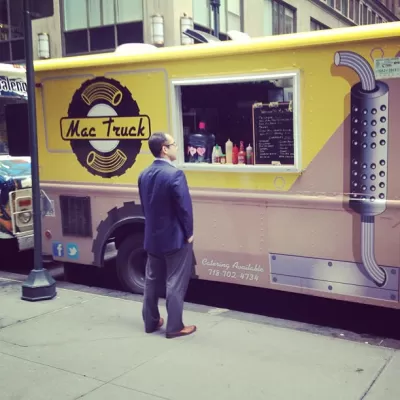
A new study from researchers at UCLA and the Washington D.C. Federal Reserve System looks at the movement and economic impact of food trucks. As Richard Florida and Aria Bendix report in City Lab, the location a food truck stops can often be tied to several factors and its impact on local economies can be beneficial.
…the study uses unique data on food trucks from the U.S. Census Bureau and a dataset of daily Washington, D.C. food truck locations, as well as social media data from Twitter and Google Trends. The study is particularly interested in the connection between food trucks and new digital technologies—especially social media—and how food trucks make use of them.
Among the factors influencing location is the use of social media, such as Twitter, to allow for last minute changes to food truck locations—giving customers last minute notice when the food truck is unable to be in their normal stop. The study also found that the availability of a variety of food trucks resulted in greater consumer spending.
FULL STORY: Why Food Trucks Locate Where They Do


Is Twitter Still an Effective Planning Tool?
Twitter has been a daily dose of drama and upheaval ever since Elon Musk offered to pay over $40 billion to buy the social media platform. Media outlets and public transit agencies had been abandoning the social media platform—should planners?
Twitter for Planners in 2022
Twitter is changing, not in the way Elon Musk wants it to, but it’s still perhaps the most useful social media platform for planners looking for education and engagement.
Only High-Income Riders Rely on Twitter for Transit Info, Study Says
A recent study by the Transit app reveals which communications methods are the most and least effective at reaching demographic groups representative of transit riders.

Planetizen Federal Action Tracker
A weekly monitor of how Trump’s orders and actions are impacting planners and planning in America.

The state-sanctioned urbicide of Austin
People don’t kill cities. Freeways do.

US to reduce Colorado River water deliveries to Mexico
A new Colorado Treaty amendment reduces Mexico’s Colorado River water allocation by 250,000 acre feet.

Colorado’s Largest Data Center Could Rise Next to Homes — Without a Public Hearing
The proposed campus would consume 11 times the power of Denver International Airport; as it has across the country, opposition mounts.

5 New England states march closer to 800 megawatt wind energy project
Securing federal approval for the project may be complicated under the Trump administration, which has historically been hostile towards domestic wind power.

Baltimore to break ground on $50 million Transit Priority Project
The project will bring faster bus trips, safer streets and better bike connections to Baltimore.

FREE Course: Walkable City 1: Why Walkability?
After describing his path towards focusing on walkability as the essence of good planning, Jeff Speck marches through his five principal reasons for making more walkable places.
Reinventing Malls: Planning Alchemy—Turning Gray Fields Into Gold
The course focuses on the opportunities and imperatives that shape reinvention of mall sites.

Eagle County Government
Harvard University Graduate School of Design
Nashville Planning Department
The Architects Foundation
University of Cincinnati Online
The Pocatello Development Authority
The Urban Renewal Agency of the City of Pocatello
Journal of the American Planning Association