The influence of Donald Shoup's classic book, "The High Cost of Free Parking," is becoming more and more apparent in more and more cities around the country.


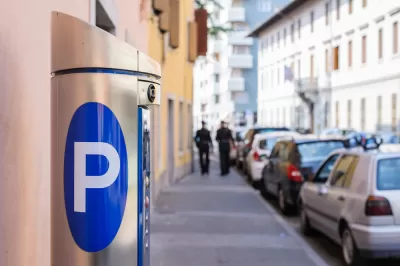
"A handful of major cities across the U.S. are changing how they charge for some of the most valuable property they manage — on-street parking spaces," writes Rebecca Beitsch to introduce an article for the Pew Charitable Trusts.
Beitsch notes that for a long time, cities haven't valued on-street parking as much as drivers have. That is all changing, however:
Now, some major cities are seeking to take advantage of their supply and motorists’ demand with so-called demand-price parking. Rather than charge a flat rate for each spot in every area of the city, they are demanding motorists pay $4, $6 or up to $8 an hour for a spot on a busy street, close to shops and restaurants, while keeping hourly prices lower on less busy streets just a few blocks over.
Beitsch is describing the tenants of parking as revolutionized by Donald Shoup, as Planetizen readers are aware, while also adding a survey of the cities undertaking new approaches to the pricing of on-street parking. Programs in Washington, D.C., San Francisco, Los Angeles, and Seattle are mentioned—each citied for unique insights into the new practices of parking management. Beitsch also deliberately addresses common concerns about the new parking programs—like if they are harmful to the poor and whether or not they achieve their intended outcomes.
Read the full story: Cities Try $6, $8 Hourly Parking to Cut Congestion, Pollution


Dynamic Parking Prices Coming to Milwaukee
One of the key elements of progressive parking policy, as recommended by Donald Shoup, is on the way to the on-street parking meters in the city of Milwaukee.

Higher Prices Created More Parking Spaces in Boston
The results of a parking pilot project are in.

Has Anyone at USDOT Read Donald Shoup?
USDOT employees, who are required to go back to the office, will receive free parking at the agency’s D.C. offices — flying in the face of a growing research body that calls for pricing parking at its real value.

Planetizen Federal Action Tracker
A weekly monitor of how Trump’s orders and actions are impacting planners and planning in America.

Amtrak, CN end decades-long dispute with eight-year agreement
The new operating agreement establishes an updated framework for the companies to work together, including processes to resolve disputes.

Judges permit Denver to divert 77,000 acre feet from the Colorado River for reservoir expansion
Overuse and climate change have caused the Colorado River’s water levels to plummet.

NYC DOT wants faster, more permanent street upgrades
The city is examining ways to build more concrete infrastructure without getting entangled in 'decades-long' projects.

'Something we’ve never seen before:' rising utility rates could strain city finances nationwide
Data centers, climate change and other factors have caused utility rates in the United States to increase by 38% since 2020.

Trump to overrule local leaders, lease millions of acres of America’s Pacific Island territories’ seafloors to mining companies
International law says that the Indigenous people of America’s territories have a right to prior and informed consent regarding projects that impact their countries.

FREE Course: Walkable City 1: Why Walkability?
After describing his path towards focusing on walkability as the essence of good planning, Jeff Speck marches through his five principal reasons for making more walkable places.
Reinventing Malls: Planning Alchemy—Turning Gray Fields Into Gold
The course focuses on the opportunities and imperatives that shape reinvention of mall sites.

Harvard University Graduate School of Design
KFH Group Inc.
Greater Baltimore Committee
The Architects Foundation
University of Cincinnati Online
The Pocatello Development Authority
The Urban Renewal Agency of the City of Pocatello