Lakeview, located north of Lincoln Park and adjacent to Lake Michigan, leads the city by a wide margin in residential teardowns over the past five years. Local developers are selling new homes for four times the original price paid.


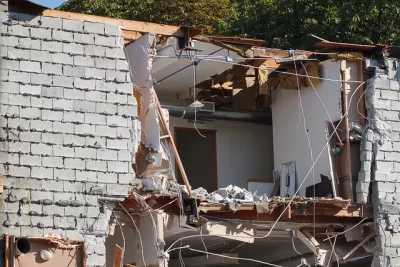
Chicago's Lakeview neighborhood is undergoing a major spate of tear-downs. Driven by demand for larger, higher-priced real estate, the area has seen many of its old homes and multifamily units replaced by single-family houses with price tags in the millions.
Dennis Rodkin writes, "In the past five years, nearly 300 older residential buildings in the neighborhood have been torn down and replaced with new homes, according to data compiled by Chicago Cityscape, which tracks building-industry permits in the city."
"In all five of those neighborhoods, 'the demand for new-construction homes is high enough that it makes financial sense to tear down what is a perfectly functioning building and put up a brand-new replacement,' said Mario Greco, [a real estate agent in the area]."
The trend doesn't bode well for those who would prefer a higher-density environment along the lake. As the process of "mansionization" continues, "Many of new single-family homes replace two- or three-flats. On the 3700 block of North Wayne Avenue, the developer who bought a greystone three-flat for $605,000 in September is marketing its replacement, a five-bedroom home with a three-car garage and a wine room, for almost $2.5 million."
Read the full story: Lakeview leads city in teardowns

Seattle Is Teardown Town
Mansionization, that conspicuous manifestation of the demand for larger homes, is alive and well in Seattle.
'Anti-Conversion Ordinance' Considered in Chicago
New zoning controls would make it harder to convert multi-unit residential buildings into single-family homes to prevent displacement in single-family neighborhoods in Chicago.
McMimpact Fee Proposed
Should there be an extra fee for property owners who tear down an existing single-family home and replace it with a much larger, more expensive single-family home?

Planetizen Federal Action Tracker
A weekly monitor of how Trump’s orders and actions are impacting planners and planning in America.

California plans to bury El Niño’s downpour
If the state plays its cards right, it may be able to store a billion acre-feet of El Niño’s water in aquifers.

Chicago breaks ground on $3 billion megadevelopment
The new neighborhood, titled Foundry Park, will one day host 3,700 residences.

California High-Speed Rail Authority CEO resigns after $600,000 scandal
Under Ian Choudri, the authority used taxpayer dollars to fund first class flights and trips to nightclubs.

Want to study the Missouri River? Soon, you may need unanimous approval from 10 states
Legislation would require 10 governors’ permission to study or build projects moving water outside the basin.

Desperate measures: Advocates weigh draining Lake Powell to fill Colorado River
Draining the reservoir could reduce evaporation losses by a couple hundred thousand acre-feet.

FREE Course: Walkable City 1: Why Walkability?
After describing his path towards focusing on walkability as the essence of good planning, Jeff Speck marches through his five principal reasons for making more walkable places.
Reinventing Malls: Planning Alchemy—Turning Gray Fields Into Gold
The course focuses on the opportunities and imperatives that shape reinvention of mall sites.

City of Rosemead
Rutgers University, Edward J. Bloustein School of Planning and Public Policy
One Hundred Miles
Hunter College, City University of New York (CUNY)
The Architects Foundation
University of Cincinnati Online
City of Cambridge
Montrose County
The Pocatello Development Authority