The futuristic transportation idea known as the Hyperloop is starting to look real. CNN Money caught up with the leaders of one of the companies working to make the dream of super-fast, efficient intercity travel a reality.



Laurie Segall reports on the progress underway in developing the Hyperloop—that infamous idea first shared by Elon Musk and then open sourced for development.
Hyperloop Technologies, as one of two companies developing the idea, has begun work on a Hyperloop test track, which can be seen in the video below.
With the test track, Hyperloop Technologies is seeking a "Kitty Hawk Moment." Their goal is to complete the test track and hit 700 miles per hour by the end of 2016. Perhaps even more boldly, Lloyd promises Segall seat 1A on the Hyperloop in the year 2021, maybe even 2020.
"When we think of moving at these speeds, and this kind of transformational technologies, [it] is a big idea," says Rob Lloyd, CEO of Hyperloop Technoligies.
Shervin Pishevar, co-founder of Hyperloop Technologies is also on hand talking about other potential benefits of the Hyperloop technology. He says the top 15 cargo ships in the world pollute more than all the cars in the world combined, so the Hyperloop could have benefits far beyond personal transportation.
Read the full story: We saw the first Hyperloop tubes in the desert

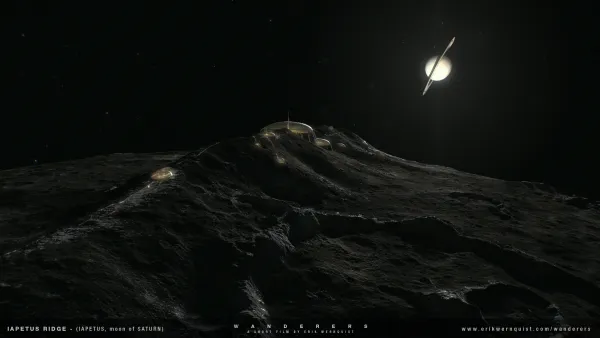
Friday Eye Candy: Stunning Visualizations of Civilization in Space
Dan Malouf shares a collection of still images taken from the four-minute film Wanderers showing "what human civilization might look like with colonies on Mars, in the asteroid belt, and on the moons of Jupiter, Saturn, and Uranus."

Friday Eye Candy: AI Envisions Solutions to the Challenges Facing Cities
Phoenix reimagined for shade. Los Angeles as a place where everybody walks. San Francisco with affordable housing. AI makes a vision of the future possible.

Friday Eye Candy: 20 AI-Generated Cityscapes
AI-generated images are creating new landscapes and cityscapes, capable of inspiring awe or fear.

Planetizen Federal Action Tracker
A weekly monitor of how Trump’s orders and actions are impacting planners and planning in America.

California plans to bury El Niño’s downpour
If the state plays its cards right, it may be able to store a billion acre-feet of El Niño’s water in aquifers.

Chicago breaks ground on $3 billion megadevelopment
The new neighborhood, titled Foundry Park, will one day host 3,700 residences.

Desperate measures: Advocates weigh draining Lake Powell to fill Colorado River
Draining the reservoir could reduce evaporation losses by a couple hundred thousand acre-feet.

This road in NYC is infamously dangerous — and Mamdani can't fix it
New York City's Ocean Parkway is known for reckless driving, but the power to implement safety measures lies with the state rather than the city.

One of Denver’s busiest corridors to gain BRT
The project will span 18 miles and contain 74 bus rapid transit stations.

FREE Course: Walkable City 1: Why Walkability?
After describing his path towards focusing on walkability as the essence of good planning, Jeff Speck marches through his five principal reasons for making more walkable places.
Reinventing Malls: Planning Alchemy—Turning Gray Fields Into Gold
The course focuses on the opportunities and imperatives that shape reinvention of mall sites.

City of Rosemead
Rutgers University, Edward J. Bloustein School of Planning and Public Policy
One Hundred Miles
Hunter College, City University of New York (CUNY)
The Architects Foundation
University of Cincinnati Online
City of Cambridge
Montrose County
The Pocatello Development Authority