Dan Malouf shares a collection of still images taken from the four-minute film Wanderers showing "what human civilization might look like with colonies on Mars, in the asteroid belt, and on the moons of Jupiter, Saturn, and Uranus."


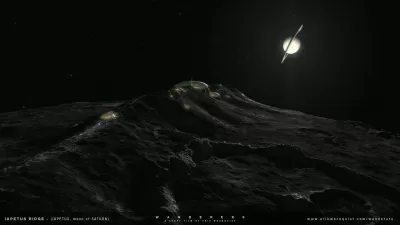
The highly recommended film, which you can watch below, is "based on real scientific ideas about what a spacegoing civilization would likely look like given foreseeable future technology." For instance there is Titan, moon of Saturn. "Titan is larger than the planet Mercury, has rivers and oceans of liquid methane, and an atmosphere thicker than Earth's. Its combination of thick atmosphere and low gravity would make it possible for humans to fly using nothing but strapped-on wings," writes Malouf.
In addition to providing the backstory on some of the stunning images created by Swedish artist Eric Wernquist for the film, Malouf also explains the film's relevance for those of us inspired by the idea of creating new technology for human civilization. In describing the "space elevators" imagined by the film, Malouf writes: "They're exactly the sort of revolutionary transportation system that could completely change how humanity organizes itself. Prosperous port cities would be sure to form at the base of any elevators ever built, like futuristic New Yorks at the mouth of a celestial Hudson River."
Read the full story: If we build cities in space, this is what they'll look like


Friday Eye Candy: A First Peek at the Hyperloop
The futuristic transportation idea known as the Hyperloop is starting to look real. CNN Money caught up with the leaders of one of the companies working to make the dream of super-fast, efficient intercity travel a reality.

What Does Sustainability Mean in Space?
NASA is developing a sustainability strategy to clean up space debris and plan for the future as near-earth orbit becomes more cluttered.
Train on the Moon? US to Explore Lunar Railway
Program proponents say this “visionary” endeavor “heralds a new era of human presence and economic activity beyond Earth.”

Planetizen Federal Action Tracker
A weekly monitor of how Trump’s orders and actions are impacting planners and planning in America.

California plans to bury El Niño’s downpour
If the state plays its cards right, it may be able to store a billion acre-feet of El Niño’s water in aquifers.

Chicago breaks ground on $3 billion megadevelopment
The new neighborhood, titled Foundry Park, will one day host 3,700 residences.

One of Denver’s busiest corridors to gain BRT
The project will span 18 miles and contain 74 bus rapid transit stations.

275,000 bus trips are at stake on Seattle's ballot
If passed, the Seattle Transit Measure would trigger a 0.3% sales tax and raise an average of $138 million per year to maintain and expand Seattle’s bus services.

Texas may pay Israeli company billions to ease water woes
Texas awarded IDE Technologies the contract for its Harbor Island project, which is slated to become the Western Hemisphere's largest desalination plant.

FREE Course: Walkable City 1: Why Walkability?
After describing his path towards focusing on walkability as the essence of good planning, Jeff Speck marches through his five principal reasons for making more walkable places.
Reinventing Malls: Planning Alchemy—Turning Gray Fields Into Gold
The course focuses on the opportunities and imperatives that shape reinvention of mall sites.

City of Rosemead
Rutgers University, Edward J. Bloustein School of Planning and Public Policy
One Hundred Miles
Hunter College, City University of New York (CUNY)
The Architects Foundation
University of Cincinnati Online
City of Cambridge
Montrose County
The Pocatello Development Authority