NASA is developing a sustainability strategy to clean up space debris and plan for the future as near-earth orbit becomes more cluttered.



NASA is taking action to clean up the growing amount of space debris littering the Earth’s orbit, reports Jessica Hullinger in Fast Company.
“In a move to protect space for the years to come, NASA recently released its new ‘Space Sustainability Strategy’ and plans to hire a director of space sustainability whose job it will be to put the strategy into effect across the agency.” The new director will be tasked with coordinating sustainability efforts across the agency.
But space is an unnatural environment that humans aren’t really supposed to inhabit, so the measures of sustainability are less obvious. If space is a lifeless vacuum, what is it that we want to protect and prioritize when operating there? The financial investments of space startups? The integrity of existing spacecraft? The usability of specific orbits? The lives of astronauts? The view of the night sky? All of the above? How do we measure these things, and how do they influence one another?
NASA is soliciting research and analysis from universities and research organizations to help answer these questions and guide their plans. “As on Earth, convincing everyone that space cannot be humanity’s dumping ground requires a clear and sustained messaging shift.”
Read the full story: Space is full of trash. NASA is finally hiring someone to clean it up

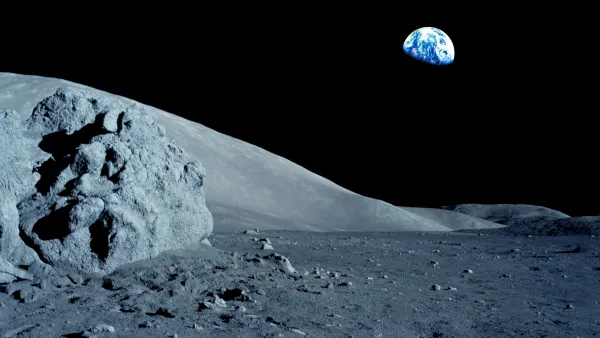
Train on the Moon? US to Explore Lunar Railway
Program proponents say this “visionary” endeavor “heralds a new era of human presence and economic activity beyond Earth.”
NASA's Urban Plan for Space Settlements
A 1977 NASA publication laid out a plan for the future of space settlements. The future of space looks very urban.

Op-ed: if transit agencies want sustainability, they should focus on their buildings
In the Washington region, buildings can account for nearly 70% of greenhouse gas emissions. If WMATA wants to be a sustainable agency, it must upgrade its developments as well as its transit.

Planetizen Federal Action Tracker
A weekly monitor of how Trump’s orders and actions are impacting planners and planning in America.

California plans to bury El Niño’s downpour
If the state plays its cards right, it may be able to store a billion acre-feet of El Niño’s water in aquifers.

Chicago breaks ground on $3 billion megadevelopment
The new neighborhood, titled Foundry Park, will one day host 3,700 residences.

California High-Speed Rail Authority CEO resigns after $600,000 scandal
Under Ian Choudri, the authority used taxpayer dollars to fund first class flights and trips to nightclubs.

Want to study the Missouri River? Soon, you may need unanimous approval from 10 states
Legislation would require 10 governors’ permission to study or build projects moving water outside the basin.

Desperate measures: Advocates weigh draining Lake Powell to fill Colorado River
Draining the reservoir could reduce evaporation losses by a couple hundred thousand acre-feet.

FREE Course: Walkable City 1: Why Walkability?
After describing his path towards focusing on walkability as the essence of good planning, Jeff Speck marches through his five principal reasons for making more walkable places.
Reinventing Malls: Planning Alchemy—Turning Gray Fields Into Gold
The course focuses on the opportunities and imperatives that shape reinvention of mall sites.

City of Rosemead
Rutgers University, Edward J. Bloustein School of Planning and Public Policy
One Hundred Miles
Hunter College, City University of New York (CUNY)
The Architects Foundation
University of Cincinnati Online
City of Cambridge
Montrose County
The Pocatello Development Authority