The state of Maryland and the city of Baltimore are partnering on a massive redevelopment effort.


"[Maryland] Gov. Larry Hogan on Tuesday announced a nearly $700 million plan to tear down thousands of vacant buildings and replace them with new developments," report Luke Broadwater and Yvonne Wenger.
The announcement includes two components, according to the article. The first is Project C.O.R.E., which will create a partnership between the city and the state to spend $94 million to demolish 4,000 vacant properties. The state will find $75 million in demolitions and the city will add $19 million. The second is "$600 million in subsidies to encourage redevelopment."
Baltimore Mayor Stephanie Rawlings-Blake is quoted on the announcement describing the project as "demolition dollars on steroids." Gov. Hogan called the city's abandoned rowhouses "hotbeds for crime."
Hat tip to Kelsey E. Thomas for sharing news of the announcement.
Read the full story: Gov. Hogan announces $700M plan to target urban decay in Baltimore

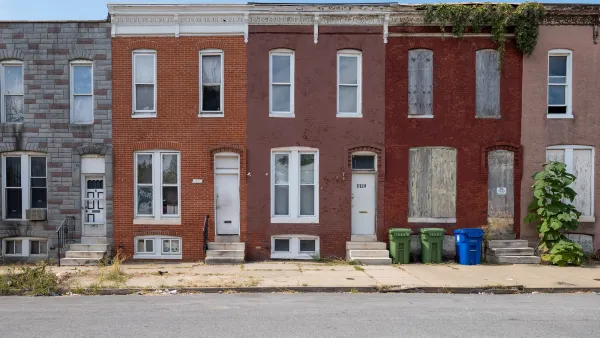
Baltimore Pushes ‘Whole Block’ Redevelopment Plan for Vacant Properties
The city will incentivize developers to take on projects that will renovate or redevelop unused city-owned properties.
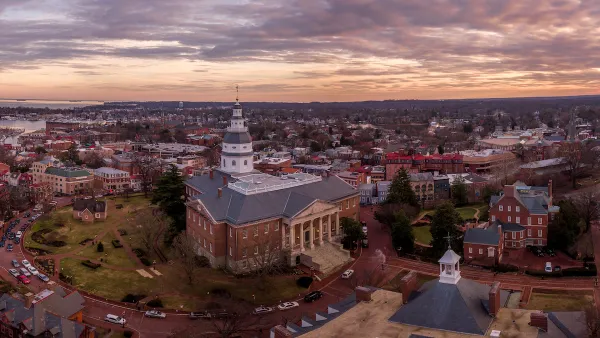
Maryland Passes New Vacancy Tax Law
The law allows local jurisdictions to set tax rates for vacant lots and properties to discourage speculation and stimulate development.
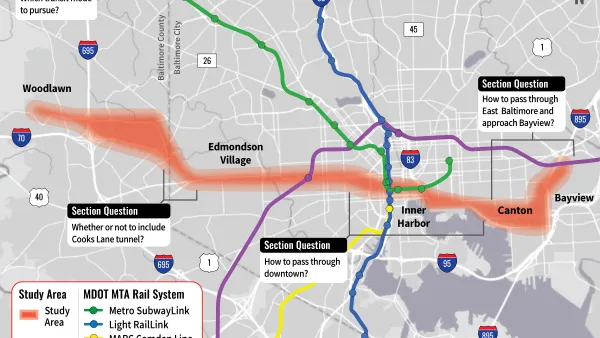
Maryland to Restart Planning for East-West Transit Line Through Baltimore
A plan for the Red Line, an east-west light rail line notoriously canceled by former-Governor Larry Hogan in 2015, is back on the table in Baltimore.

Planetizen Federal Action Tracker
A weekly monitor of how Trump’s orders and actions are impacting planners and planning in America.

California plans to bury El Niño’s downpour
If the state plays its cards right, it may be able to store a billion acre-feet of El Niño’s water in aquifers.

Chicago breaks ground on $3 billion megadevelopment
The new neighborhood, titled Foundry Park, will one day host 3,700 residences.

California High-Speed Rail Authority CEO resigns after $600,000 scandal
Under Ian Choudri, the authority used taxpayer dollars to fund first class flights and trips to nightclubs.

Want to study the Missouri River? Soon, you may need unanimous approval from 10 states
Legislation would require 10 governors’ permission to study or build projects moving water outside the basin.

Desperate measures: Advocates weigh draining Lake Powell to fill Colorado River
Draining the reservoir could reduce evaporation losses by a couple hundred thousand acre-feet.

FREE Course: Walkable City 1: Why Walkability?
After describing his path towards focusing on walkability as the essence of good planning, Jeff Speck marches through his five principal reasons for making more walkable places.
Reinventing Malls: Planning Alchemy—Turning Gray Fields Into Gold
The course focuses on the opportunities and imperatives that shape reinvention of mall sites.

City of Rosemead
Rutgers University, Edward J. Bloustein School of Planning and Public Policy
One Hundred Miles
Hunter College, City University of New York (CUNY)
The Architects Foundation
University of Cincinnati Online
City of Cambridge
Montrose County
The Pocatello Development Authority