A complaint filed with the U.S. Department of Transportation alleges that Maryland Gov. Hogan's decision to cancel the long-planned Red Line rail project violates the Civil Rights Act.


The decision by Maryland Governor Larry Hogan to cancel the Red Line rail project has had continuing blowback, according to an article by Emily Badger, and the situation exemplifies a common inequity in transportation investment around the country.
A coalition of civil rights groups filed a complaint earlier this week with the federal Department of Transportation that the decision violated the Civil Rights Act. "By nixing the transit project — particularly in favor of rural and suburban highway funding — the state will disproportionately harm African Americans," explains Badger of the complaint.
The article includes quotes and background from Sherrilyn Ifill, president and director-counsel for the NAACP Legal Defense and Education Fund, which led the complaint, to explain how the complaint connects the issues of transportation and civil rights. From the complaint itself: "the cancellation of the Red Line Project, rather than being a cost-saving measure, was simply a naked transfer of resources from the project corridor’s primarily African-American population to other rural and suburban parts of the state…"
Ifill also suggests that transportation contributed directly to the unrest that followed the death of Freddie Gray while in the custody of Baltimore police. "As much attention as we give to the trial of the officers who were charged in the killing of Freddie Gray...we should give to a decision that implicates 10,000 construction jobs and billions of infrastructure investment in Baltimore that were eliminated in a single day, by a single decision, made by a single person."
Read the full story: The next civil rights issue of our time
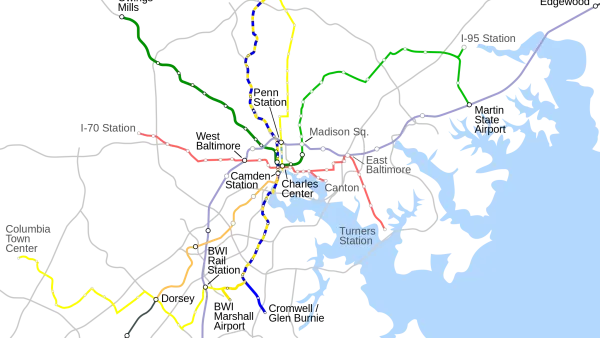
Op-Ed: Maryland Governor Is No Friend to Transit
According to this editorial, Governor Larry Hogan's decision to halt a planned $2.9 billion light rail line betrays a politically-motivated preference for roads.
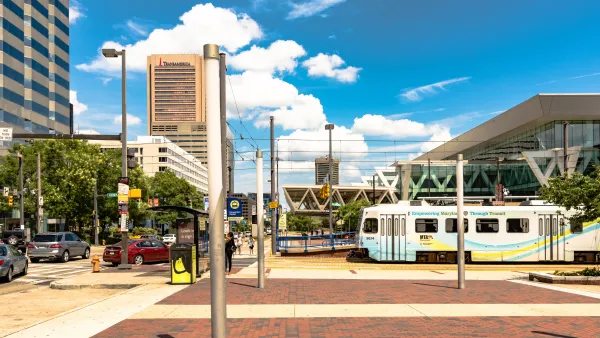
Light Rail It Is for Baltimore’s Red Line Project
The decision to go with light rail over bus rapid transit will be more expensive and take longer to complete, but proponents say it’s an investment in Baltimore’s economic future.
Feds Pause Baltimore Red Line Permits
The MTA says it is committed to continuing work on the light rail project, but the pause signals a potential shift in federal funding for the east-west line.

Planetizen Federal Action Tracker
A weekly monitor of how Trump’s orders and actions are impacting planners and planning in America.

Eastern Nebraska is running out of electricity
Data centers and electrification are straining eastern Nebraska’s grid, throttling economic development.

Move over, LA: St. Louis gears up for Olympics, invests millions in downtown redevelopment
The Missouri city will host the 2028 Olympic soccer group stage and knockout matches.

Dallas releases zoning code overhaul to officials
The drafted overhaul is over 400 pages long.

NYC renovations for dangerous, ‘mercilessly crammed’ street delayed until 2027
Construction was supposed to begin this fall.

San Diego’s Midway Rising project gets greenlight from city council
The project looks to become the largest affordable housing development in California's history.

FREE Course: Walkable City 1: Why Walkability?
After describing his path towards focusing on walkability as the essence of good planning, Jeff Speck marches through his five principal reasons for making more walkable places.
Reinventing Malls: Planning Alchemy—Turning Gray Fields Into Gold
The course focuses on the opportunities and imperatives that shape reinvention of mall sites.

City of Rosemead
Rutgers University, Edward J. Bloustein School of Planning and Public Policy
One Hundred Miles
University of Michigan School for Environment and Sustainability (SEAS)
Hunter College, City University of New York (CUNY)
The Architects Foundation
City of Cambridge
The Pocatello Development Authority
The Urban Renewal Agency of the City of Pocatello