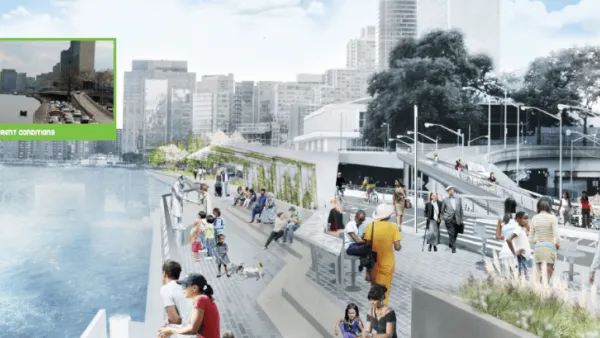
Perkins Eastman has created a splashy proposal for a linear, at-grade park running along a long stretch of one of New York's most famous avenues.


Alan G. Brake details a highly conceptual proposal that would "would see New York's iconic Broadway converted into a linear park running from Columbus Circle to Union Square." The architecture firm Perkins Eastman created the proposal, citing the benefits to pedestrians and cyclists, as well as to the city's stormwater infrastructure. "Based on the success of the High Line, the designers argue the proposal would increase property values and therefore would pay for itself," adds Brake.
Brake also notes that New York City is experiencing a bit of a park design moment riding on the heels of the High Line's success. Design proposals for the Lowline, the Big U around Lower Manhattan, and a $170 million proposal to makeover Pier 54.
The news caught the attention of other urban design-focused publications. Kriston Capps writes for CityLab that the proposal combines two of the "best-loved" land use projects of the Bloomberg era in New York City: the High Line and closing Times Square to cars.
Writing for The Architect's Newspaper, Audrey Wachs notes the project's "Bilbao Effect" ambitions (i.e., "culture-led revitalization of a postindustrial city driven by a single institution housed in a starchitect-designed complex…").
FULL STORY: Perkins Eastman proposes turning New York's Broadway into one long park


The Once and Future Park Avenue Promenade
The debate about whether the pedestrian-oriented changes made to the New York City streetscape during the pandemic should be permanent has a high-profile battleground on Park Avenue.
Court Decision Clears the Way for East River Greenway Bike Bridge
A community group had sued to prevent the construction of a bridge in Clara Coffey Park in New York City. The court ruled in the favor of the city's plans.
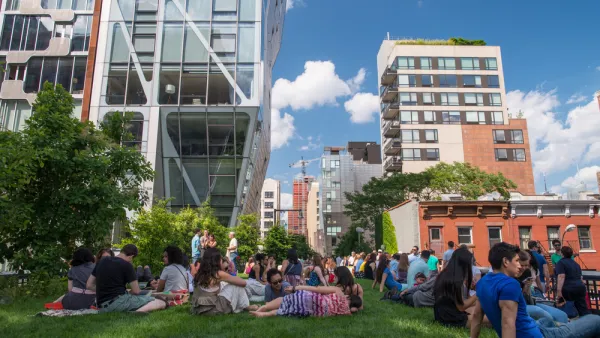
Ten Years of the High Line—Time to Reflect
As the High Line turns ten, a debate about the costs and benefits of urban revitalization continues.

Planetizen Federal Action Tracker
A weekly monitor of how Trump’s orders and actions are impacting planners and planning in America.

The state-sanctioned urbicide of Austin
People don’t kill cities. Freeways do.

US to reduce Colorado River water deliveries to Mexico
A new Colorado Treaty amendment reduces Mexico’s Colorado River water allocation by 250,000 acre feet.

5 New England states march closer to 800 megawatt wind energy project
Securing federal approval for the project may be complicated under the Trump administration, which has historically been hostile towards domestic wind power.

Baltimore to break ground on $50 million Transit Priority Project
The project will bring faster bus trips, safer streets and better bike connections to Baltimore.

Airbnb launches $250 million 'last-dollar financing' housing accelerator, makes first investment in Austin
The company will put $6.4 million towards affordable housing development in Texas’ capital.

FREE Course: Walkable City 1: Why Walkability?
After describing his path towards focusing on walkability as the essence of good planning, Jeff Speck marches through his five principal reasons for making more walkable places.
Reinventing Malls: Planning Alchemy—Turning Gray Fields Into Gold
The course focuses on the opportunities and imperatives that shape reinvention of mall sites.

Eagle County Government
Harvard University Graduate School of Design
Nashville Planning Department
The Architects Foundation
University of Cincinnati Online
The Pocatello Development Authority
The Urban Renewal Agency of the City of Pocatello
Journal of the American Planning Association