Responding to the leading complaint about the Portland Streetcar—that they move too slow to be useful compared to other modes—service will temporarily make fewer stops along routes in the Pearl District and Downtown.


"Portland Streetcar is planning to temporarily close five stops in downtown Portland and the Pearl District in an effort to speed up travel," reports Elliot Njus.
"The trial, expected to begin in February and last at least a month, targets places where frequent stops take a toll on travel time and where collisions tend to block tracks and take trains out of service."
According to Njus, the speed of the streetcar is the number one complaint of both riders and non-riders. The month-long trail will allow Portland Streetcar Inc. to collect data on the operation of the system to determine whether the measures were sufficient to improve the speed of the system.
The decision to consolidate—or "thin"—stops is also on the table in Los Angeles, where the county transit agency is considering a plan that would remove stops for the bus system in the hopes of speeding up buses as they travel along their route.
Read the full story: Portland Streetcar to try limiting stops to speed service

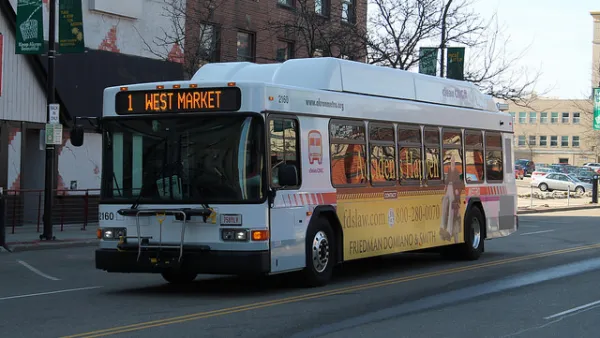
Akron Putting Finishing Touches on Bus System Overhaul
Akron Metro RTA recently announced the details of an overhaul of its bus system—the reorganization will affect every one of the system's 36 fixed bus routes.
District DOT Considering Stop Consolidation to Speed Up Transit
The tough task of removing bus stops to speed up travel times is on the table in Washington, D.C.
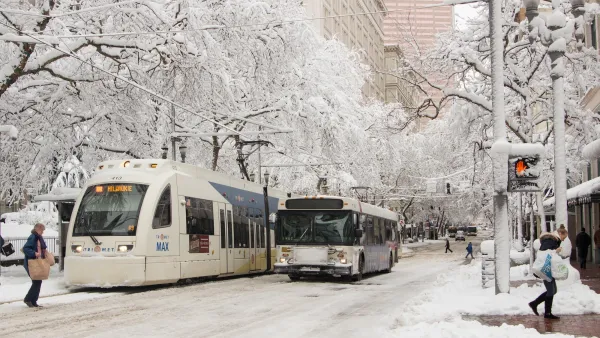
Portland Transit is About to Get a Lot Worse
TriMet is making multiple rounds of service cuts this year as the agency faces a $300 million budget shortfall.

Planetizen Federal Action Tracker
A weekly monitor of how Trump’s orders and actions are impacting planners and planning in America.

The state-sanctioned urbicide of Austin
People don’t kill cities. Freeways do.

US to reduce Colorado River water deliveries to Mexico
A new Colorado Treaty amendment reduces Mexico’s Colorado River water allocation by 250,000 acre feet.

Nation's most wind-powered state turns to coal as data centers increase energy demand
For the first time in decades, Iowa has increased its generation of coal power.

NYC cools commuters with city's first rain garden above a bus stop
New York City officials say the plants in the rain garden can absorb 16 gallons of rainwater during heavy storms.

Brightline West’s future may rely on $6 billion federal loan
The company has until Nov. 2 to make a $400 million equity investment into its proposed high-speed rail line.

FREE Course: Walkable City 1: Why Walkability?
After describing his path towards focusing on walkability as the essence of good planning, Jeff Speck marches through his five principal reasons for making more walkable places.
Reinventing Malls: Planning Alchemy—Turning Gray Fields Into Gold
The course focuses on the opportunities and imperatives that shape reinvention of mall sites.

Eagle County Government
Harvard University Graduate School of Design
Nashville Planning Department
The Architects Foundation
University of Cincinnati Online
The Pocatello Development Authority
The Urban Renewal Agency of the City of Pocatello
Journal of the American Planning Association