Triple Pundit takes a step back to gather some perspective, asking why the U.S. commuters are still so resistant to getting on bikes.


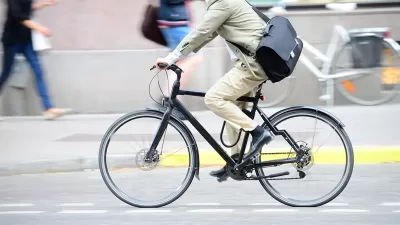
A frank assessment from Anum Yoon: "Though cycling to work has the potential to reduce your carbon footprint and improve your overall health, you’re probably not doing it." Yes, biking and the infrastructure that makes it possible has made considerable gains in recent years, but "the sad fact remains that the U.S. still lags far behind European nations when it comes to bicycle commuting."
The article includes lots of infographics to drive home the point about the gap between the number of bike riders in the United States compared to countries around the world.
The argument of the article, including the presentation made by the infographics, is concerned with answering the question of why there is a tale of two continents when it comes to bike mode share. Interestingly, infrastructure is only part of the answer. One simple explanation: U.S. culture considers biking a recreational activity—not a transportation mode worthy of the daily commute.
Read the full story: Bike Commuting: Why the U.S. is Far Behind Other Nations
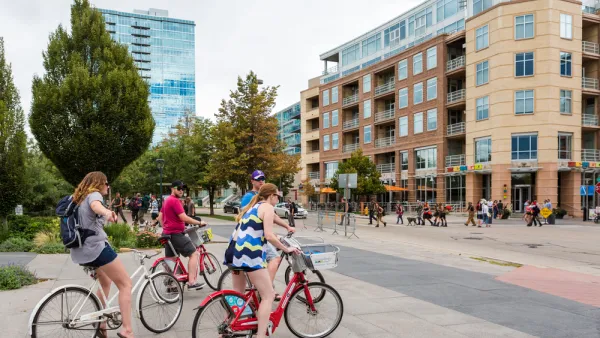
Study: More Bike Infrastructure Could Prevent 15,000 Deaths Annually
In addition to reducing air pollution and congestion, improving bike infrastructure could save thousands of lives each year, according to new research.
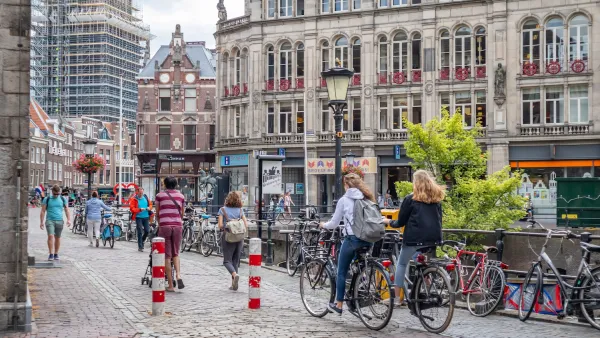
2025's 30 Most Bike-friendly Cities
Copenhagenize has released its list of top cities for cyclists. Spoiler alert: the United States doesn’t make the list.
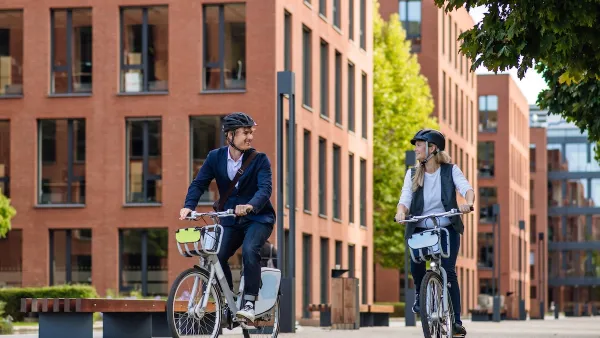
7 Ways Cyclists are Winning in the AI Revolution
For individual cyclists and transportation planners, AI offers some useful tools for understanding bike riders’ behavior and assessing gaps in a city’s bike infrastructure.

Planetizen Federal Action Tracker
A weekly monitor of how Trump’s orders and actions are impacting planners and planning in America.

California plans to bury El Niño’s downpour
If the state plays its cards right, it may be able to store a billion acre-feet of El Niño’s water in aquifers.

Desperate measures: Advocates weigh draining Lake Powell to fill Colorado River
Draining the reservoir could reduce evaporation losses by a couple hundred thousand acre-feet.

Los Angeles just elected an urban planner as its mayor
Transportation analysts are optimistic that Raman will be more aggressive in addressing transit issues than Bass.

Mamdani’s pied-à-terre tax survives legal challenge
A panel of judges found that the plaintiffs failed to demonstrate injury as a result of New York City's implementation of the tax.

Eastern Nebraska is running out of electricity
Data centers and electrification are straining eastern Nebraska’s grid, throttling economic development.

FREE Course: Walkable City 1: Why Walkability?
After describing his path towards focusing on walkability as the essence of good planning, Jeff Speck marches through his five principal reasons for making more walkable places.
Reinventing Malls: Planning Alchemy—Turning Gray Fields Into Gold
The course focuses on the opportunities and imperatives that shape reinvention of mall sites.

City of Rosemead
Rutgers University, Edward J. Bloustein School of Planning and Public Policy
One Hundred Miles
University of Michigan School for Environment and Sustainability (SEAS)
Hunter College, City University of New York (CUNY)
The Architects Foundation
City of Cambridge
Montrose County
The Pocatello Development Authority