Shell Oil surprised the environmental community in September by announcing an end to Arctic drilling. What could come next? Shell is abandoning plans for the Carmon Creek oil-sands project in Alberta and taking a $2 billion write-down.


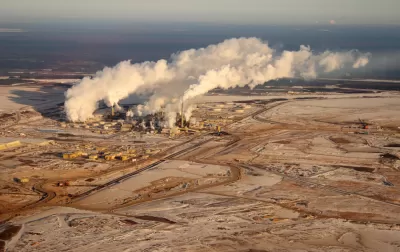
"Energy producers are canceling or delaying projects as a crude price slump forces them to prioritize spending," writes Rebecca Penty. "The company (in late September) abandoned drilling offshore Alaska indefinitely after it failed to find enough oil or gas in the Chukchi Sea."
Shell is halting work on the 80,000 barrel-a-day Carmon Creek drilling development after deciding the project couldn’t compete in its portfolio, the company announced in a statement Tuesday (Oct. 27). Carmon Creek is the first project in the downturn to be shelved after being sanctioned."
Shell Oil is not alone in cutting back their oil sands operations. They join "Suncor Energy Inc. and Cenovus Energy Inc. in deferring investment this year in the oil sands, one of the most expensive places to extract crude," writes Penty. "Oil-sands projects were struggling to compete against lower-cost U.S. shale and offshore developments even before the price of crude plunged."
"Earlier this year, three major Canadian energy companies said they would stop new or expanded oil-sands ventures, and last year French oil company Total SA and Statoil ASA of Norway put off plans," writes Christopher Harder for The Wall Street Journal Energy Journal.
In addition to the high cost of drilling in the oil sands combined with slumping crude prices, the lack of pipeline infrastructure plays a significant role.
All four proposals for new large-scale oil pipelines to ship Alberta crude to the continent’s coasts have been delayed by environmental opposition and regulatory scrutiny, including the Keystone XL line that’s in its eighth year of U.S. review.
Tip of the iceberg? (pardon the metaphor)
"It’s getting even tougher for the world’s third-largest reserves in Canada to attract investment with prices for West Texas Intermediate (WTI) and Brent crudes both hovering below $50 a barrel," writes Penty.
With this new Shell announcement, 18 future oil-sands announcements have been delayed this year,” Jackie Forrest, vice-president of Calgary-based ARC Financial Corp., said in a phone interview. “Many of the other ones were not as expensive to cancel because not as much had been spent on them."
While the Carmon Creek write-off of $2 billion is significant, the write-off for the Chukchi Sea offshore operation off Alaska could be as high as $9 billion.
Brad Plumer of Vox media goes into greater depth on the economics of oil sands development.
The Guardian expands on the write-off and cost losses affecting Shell from halting both Arctic and oil sands developments.
Read the full story: Shell Halts Alberta Oil-Sands Project After Leaving Arctic
$7 Billion Later, Shell to Withdraw from Arctic Oil Drilling
Environmentalists could have saved themselves a lot of demonstrating had they known that Shell Oil would pack up their drilling rigs after only six weeks of exploratory drilling in the Chukchi Sea off Alaska. Insufficient oil and other reasons cited.

Just What the Planet Needs: More Oil Production
A surge of oil from four countries—Norway, Guyana, Canada and Brazil—will more than compensate for slowing growth of U.S. oil production. The new sources might cause oil prices to dip to $50 a barrel and slow the transition to electric vehicles.
Nebraska Supreme Court OKs Keystone XL; U.S. Senate has the Next Move
The House voted for the tenth time to approve the pipeline, and a split decision by the Nebraska Supreme Court removes a key objection of President Barack Obama to ruling on Keystone XL. The Senate begins debate Monday.

Planetizen Federal Action Tracker
A weekly monitor of how Trump’s orders and actions are impacting planners and planning in America.

Eastern Nebraska is running out of electricity
Data centers and electrification are straining eastern Nebraska’s grid, throttling economic development.

Washington state to charge fee to drivers with fuel-efficient cars
Revenue from the fee will go towards supporting the state’s highways.

Instead of building new housing, LA developers are turning mansions into mega-mansions
In the richest areas, the number of houses valued at $30 million with demolition permits has skyrocketed since 2018.

Illinois considers spending $1 billion in taxpayer money on data center
A quantum computing campus and data center are currently under construction in Chicago.

As development costs rise, Boston moves to lessen affordable housing requirements
The Boston Zoning Commission and the City Council still need to approve Boston Mayor Michelle Wu’s proposed changes

FREE Course: Walkable City 1: Why Walkability?
After describing his path towards focusing on walkability as the essence of good planning, Jeff Speck marches through his five principal reasons for making more walkable places.
Reinventing Malls: Planning Alchemy—Turning Gray Fields Into Gold
The course focuses on the opportunities and imperatives that shape reinvention of mall sites.

City of Charlotte
City of Rosemead
Rutgers University, Edward J. Bloustein School of Planning and Public Policy
University of Michigan School for Environment and Sustainability (SEAS)
Hunter College, City University of New York (CUNY)
The Architects Foundation
University District Partnership
City of Cambridge
The Pocatello Development Authority