It is difficult to imagine a time when Los Angeles' freeways symbolized access, efficiency, and modernity. Now that the city's love affair with freeways is nearly spent, what future do we envision for them?


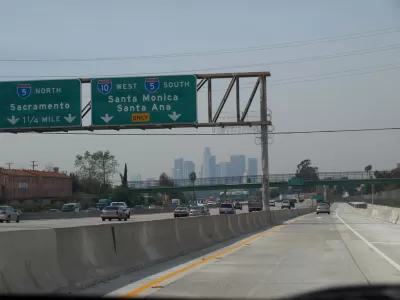
Christopher Hawthorne reminds us that in the recent past, Los Angeles' freeways heralded a bright future. "This praise had a way of edging toward the religious. [Writer David] Brodsly called the post-war L.A. freeway 'the cathedral of its time and place.' Joan Didion famously wrote that freeway driving offered 'the only secular communion Los Angeles has.'"
Residents still use freeways out of necessity, but they're far from loved. Instead they represent wasted time and polluted air, one of many factors seen as holding the city back. Hawthorne writes, "[The private car] is drifting steadily from the center of the region's self-image.[...] Increasingly the fundamental task Los Angeles faces is one of re-urbanization — of infill development, of reanimating or repairing the public realm."
The article criticizes freeways as an urban monoculture, dedicated to a single use, dividing central areas to favor sprawl. Many agree that L.A. needs to lose its addiction to big roads. But what should happen to the immense freeway infrastructure already in place? Can these aging 'cathedrals' be repurposed?
Read the full story: Why the time is right to re-examine the L.A. freeway
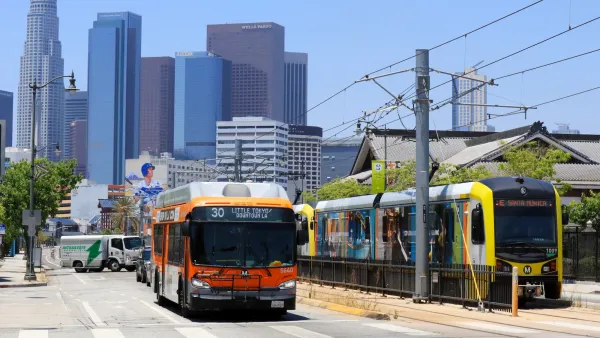
LA Metro Increases Highway Expansion Budget by 40%
Metro has plans to expand freeways including the 5, 105, and 405, among others.
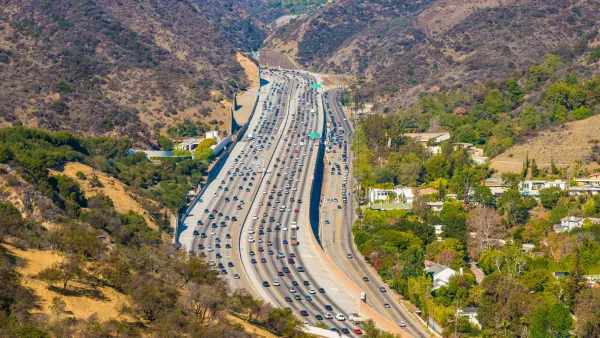
Congestion Pricing Could Be Coming to L.A.
The infamously car-centric city is weighing a proposed congestion pricing pilot program to reduce traffic and encourage public transit use.
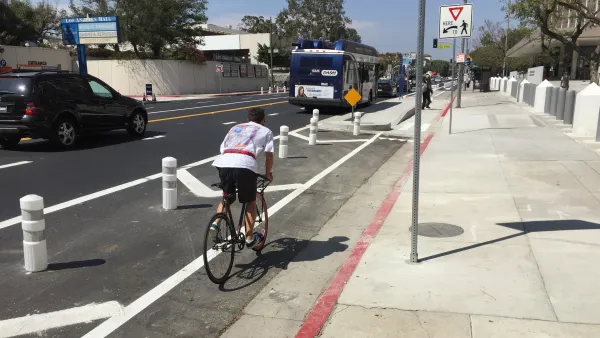
Opinion: Los Angeles Must Prioritize Bikes and Buses
L.A. has a plan for improving mobility. Why are city leaders ignoring it?

Planetizen Federal Action Tracker
A weekly monitor of how Trump’s orders and actions are impacting planners and planning in America.

California plans to bury El Niño’s downpour
If the state plays its cards right, it may be able to store a billion acre-feet of El Niño’s water in aquifers.

Desperate measures: Advocates weigh draining Lake Powell to fill Colorado River
Draining the reservoir could reduce evaporation losses by a couple hundred thousand acre-feet.

Chicago voters approve permanent festival grounds, penalty for vacant property owners
Currently, major summer and fall festivals take over public parks for weeks at a time, drawing criticism from nearby residents

NYC votes to cut outdoor dining red tape, speed up permitting
New York City also voted to allow the Department of Transportation to begin work on urgent projects before notifying elected officials.

California appears to reject Prop. 45
The proposition would have expanded the projects that qualify for a streamlined environmental review, effectively paring down the California Environmental Quality Act.

FREE Course: Walkable City 1: Why Walkability?
After describing his path towards focusing on walkability as the essence of good planning, Jeff Speck marches through his five principal reasons for making more walkable places.
Reinventing Malls: Planning Alchemy—Turning Gray Fields Into Gold
The course focuses on the opportunities and imperatives that shape reinvention of mall sites.

City of Rosemead
Rutgers University, Edward J. Bloustein School of Planning and Public Policy
One Hundred Miles
Hunter College, City University of New York (CUNY)
The Architects Foundation
University of Cincinnati Online
City of Cambridge
Montrose County
The Pocatello Development Authority