Brown lawns may be less aesthetically pleasing than synthetic lawns, but are they safer?



California Governor Jerry Brown has called for 50 million square feet of lawns in the state to be removed; water districts across the state are offering rebates for lawn removal; and cities across the thirsty state impose fines on residents who water their lawns too often.
Thus it is that the state's capital is wrestling with the merits of a 30-year-old ban on artificial turf in front yards. According to Joy Patterson, principal planner for the city's Planning and Design Commission, the origins of the rule stem from aesthetic concerns. She explains that the turf of 1984 was used primarily for commercial applications and golf courses, but modern-day turf has evolved to look more like real grass.
"A review by Planning Commission staff, at the request of Councilman Jeff Harris, found artificial turf to be drought tolerant, with excellent built-in drainage and no irrigation requirements," reports Brenna Lyles for the Sacramento Bee.
But residents and Planning officials have environmental and safety concerns about the materials used to manufacture such life-like grass. Among other things, writes Lyles, residents "have questioned the safety of the ground-up, recycled tires that make up the tiny ‘crumb rubber’ pellets that are intended to give the surface more bounce and mimic dirt."
Councilwoman Angelique Ashby is not on board. "There's probably no way I would support it, ever. But, I would at least encourage my colleagues to consider how are we going to do enforcement so that we make sure that it's high quality, and that it doesn't have toxic runoff and that it is recycled appropriately if we're gonna use it, and that it is installed appropriately. How would we properly monitor those things?"
Read the full story: Sacramento planning commission to consider allowing artificial turf in front yards


Instead of water, sediment from droughts and wildfire is choking U.S. dams
Sediment has filled 8% of dam storage capacity in the United States. Because of climate change, researchers expect it will only accumulate quicker.
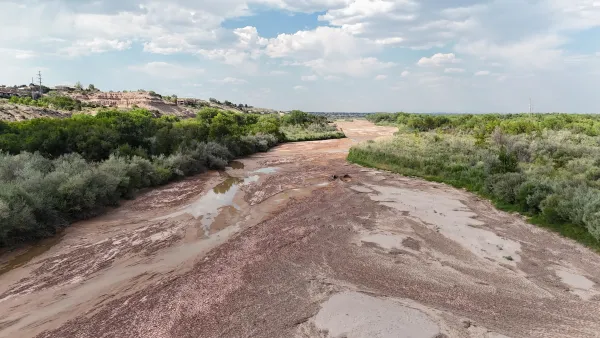
15 million people rely on the Rio Grande — in 2 years, it may run dry
The river fuels billions of dollars in agricultural production. Reducing agricultural water use may be the only way to save it.

Data center provider partners with “cloud seeding” company to artificially trigger rainfall
With cloud seeding, planes or drones release salt compounds into clouds to make them produce rain.

Planetizen Federal Action Tracker
A weekly monitor of how Trump’s orders and actions are impacting planners and planning in America.

Amtrak, CN end decades-long dispute with eight-year agreement
The new operating agreement establishes an updated framework for the companies to work together, including processes to resolve disputes.

Judges permit Denver to divert 77,000 acre feet from the Colorado River for reservoir expansion
Overuse and climate change have caused the Colorado River’s water levels to plummet.

Idaho may see an 18% drop in federal surface transit funding — the largest estimated cut in the US
Transit systems in rural communities are much more reliant on federal funding to provide their services.

How ‘post-disaster gentrification’ alters neighborhoods after natural calamities
After hurricanes, fires or other calamities, the original residents of a community are often replaced by younger, wealthier residents.

Maryland local governments examine if they should have more power to raise property taxes
Maryland’s housing market is out of reach for the majority of moderate-income residents.

FREE Course: Walkable City 1: Why Walkability?
After describing his path towards focusing on walkability as the essence of good planning, Jeff Speck marches through his five principal reasons for making more walkable places.
Reinventing Malls: Planning Alchemy—Turning Gray Fields Into Gold
The course focuses on the opportunities and imperatives that shape reinvention of mall sites.

Harvard University Graduate School of Design
KFH Group Inc.
Greater Baltimore Committee
The Architects Foundation
University of Cincinnati Online
The Pocatello Development Authority
The Urban Renewal Agency of the City of Pocatello