The Environmental Protection Agency finds itself in a peculiar place. Normally it investigates spills caused by the private sector. Now it's cleaning up a massive spill it caused while investigating a leak at an abandoned mine in southwest Colorado.


The Environmental Protection Agency was investigating a leak at the abandoned Gold King Mine in La Plata County (see Denver Post map) on August 5 when it accidentally opened the mine tunnel, triggering a spill of about a million gallons of wastewater into a tributary of the Animas River, turning the river into "a murky, mustard shade of yellow."
On Sunday, both Durango, county seat of La Plata, and the county declared a "state of local emergency."
"E.P.A. officials confirmed the leak contained heavy metals, including lead and arsenic, but said it was too early to know whether there was a health risk to humans or animals.," writes Daniel Victor for The New York Times. An EPA-supervised crew was working to clean the spill though it was expected to enter New Mexico.
From the description provided by Bruce Finley of The Denver Post, it certainly sounded unhealthy:
The soupy yellow-orange Animas River contains arsenic, lead, cadmium, aluminum and copper — among other potentially toxic heavy metals — "at varying levels," the officials said in a packed public meeting.
For an entire list of metal concentrations and pH levels, click on the "documents" link on Gold King Mine Blowout Incident page.
"This is a huge tragedy. It’s hard being on the other side of this," said Dave Ostrander, the E.P.A.’s director of emergency preparedness for Region 8. "Typically we respond to emergencies, we don’t cause them.”
The Animas River flows into the San Juan River which meets the Colorado River at Lake Powell.
"And EPA officials at a command post in Durango could not rule out the possibility that contaminants will remain concentrated enough to appear yellow on Sunday when the plume is expected to approach Lake Powell and the Grand Canyon, carved by the Colorado River," writes Finley.
Read the full story: Wastewater Spill in Colorado Turns a River Yellow

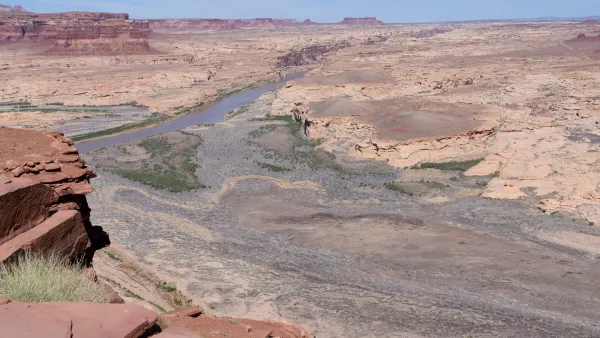
Feds say Arizona, California and Nevada must cut Colorado River water use by 1.25 million acre-feet
The new plan does not apply mandatory cuts to any of the river’s upper basin states.
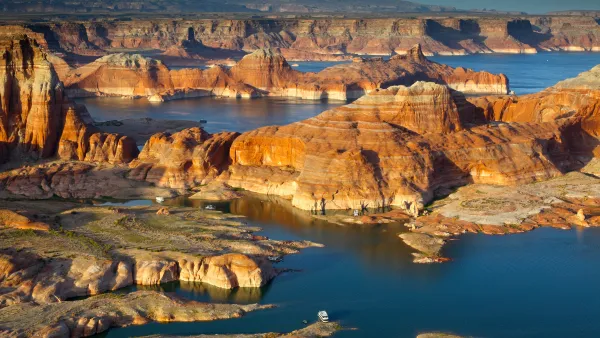
Even a “best case scenario” El Niño won't fix the West’s drought
While lower basin states may see increased precipitation, increased snowfall in upper basin states is needed to bring sufficient water to the West.
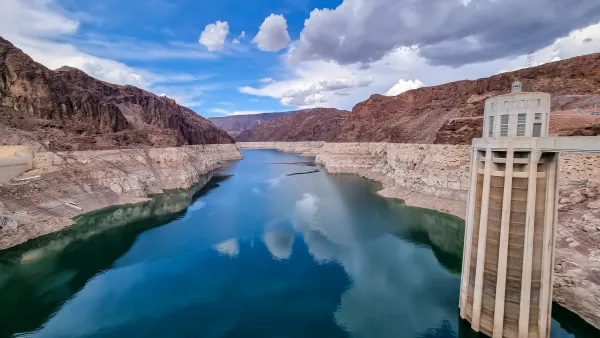
Why a Colorado River water conservation agreement is so hard to reach
As the nation's two largest reservoirs hit their lowest levels on record, what would it take to avert the crisis? An expert weighs in.

Planetizen Federal Action Tracker
A weekly monitor of how Trump’s orders and actions are impacting planners and planning in America.

Amtrak, CN end decades-long dispute with eight-year agreement
The new operating agreement establishes an updated framework for the companies to work together, including processes to resolve disputes.

Northwest rail fans eager for Sept. 30 debut of Amtrak’s Airo fleet
Get ready for that new train smell and more seats. But they won’t go faster or run more frequently on the Cascades route in Washington and Oregon.

Brightline Florida files for bankruptcy
The transit company is over $5 billion in debt.

St. Louis Metro to test if single-car trains can reduce operating costs, maintain rider satisfaction
The pilot program will run from October to spring 2027, and begin with one single-car train operating on Metrolink’s Red and Blue lines.

Pennsylvania is building data centers in abandoned mines
Housing data centers in mines provides an alternative to destroying local forests and may spare residents from data centers’ noise and air pollution.

FREE Course: Walkable City 1: Why Walkability?
After describing his path towards focusing on walkability as the essence of good planning, Jeff Speck marches through his five principal reasons for making more walkable places.
Reinventing Malls: Planning Alchemy—Turning Gray Fields Into Gold
The course focuses on the opportunities and imperatives that shape reinvention of mall sites.

City of Thousand Oaks
City of Wisconsin Rapids
Harvard University Graduate School of Design
The Architects Foundation
University of Cincinnati Online
The Pocatello Development Authority
The Urban Renewal Agency of the City of Pocatello