Buffalo made its fortune in long-gone heavy industries such as steel. Now a new industrial revolution—in renewable energy—is bringing new life to the coldest, northernmost city of the American Rust Belt.


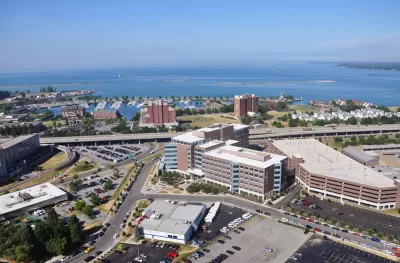
Now, things are turning around. Aided in part by a $1 billion redevelopment assistance plan from the state, the Buffalo region now has a healthy 5.3 percent unemployment rate. Some of those jobs are at high-tech companies, including Yahoo, that are capitalizing on the region's cheap energy, powered by Niagra Falls, which the defunct factories no longer use. Cheap real estate doesn't hurt either. Equally importantly, an emerging industrial economy is taking the place of the old one, building turbines and windmills near places that used to make girders and rails. There's a green energy complex, and the solar power company SolarCity has built a factory.
"Under the [redevelopment] plan, developed after a study from the Brookings Institution along with local community and business organizations, the state is trying to seed a cluster economy, Gov. Andrew Cuomo said, targeting several areas, including advanced manufacturing, health and life sciences and tourism. Seeing the opportunities for renewable energy came out of that process."
While the region has an extensive industrial infrastructure, it also has a robust social infrastructure, which has stuck around since Buffalo's heyday.
"Despite the long decline, much of that infrastructure remains — including transmission and rail lines, professional schools and fine art museums. All of that, along with generous government subsidies, is proving attractive to new industries like clean energy and advanced manufacturing."
The city is even attracting hipsters.
"Nowhere is the transformation more evident than in Larkinville, a collection of 19th-century buildings once clustered around the Larkin Soap Company that has become a work, entertainment and dining destination inspired by similar districts like Dumbo and Williamsburg, Brooklyn."
Read the full story: The Wind and Sun Are Bringing the Shine Back to Buffalo

Economic Recovery in Legacy Cities
Americans living in legacy cities face a unique set of challenges and opportunities in recovering from the COVID-19 pandemic. Several local, state, and federal support strategies could aid these cities in recouping losses.
Rustbelt Cities Continue to Make Play for Millennials
From St. Louis to Baltimore, the Rustbelt Cities are seeing a growing population of millennials as a possible cure to shrinking populations and stagnating economies.

Is 'Brain Drain' a Legitimate Problem?
According to analysts like Aaron Renn, the exodus of educated Millennials from what some perceive to be less-glamorous cities shouldn't signal impending doom. For one thing, brain drain might not be happening at all.

Planetizen Federal Action Tracker
A weekly monitor of how Trump’s orders and actions are impacting planners and planning in America.

Amtrak, CN end decades-long dispute with eight-year agreement
The new operating agreement establishes an updated framework for the companies to work together, including processes to resolve disputes.

Northwest rail fans eager for Sept. 30 debut of Amtrak’s Airo fleet
Get ready for that new train smell and more seats. But they won’t go faster or run more frequently on the Cascades route in Washington and Oregon.

Brightline Florida files for bankruptcy
The transit company is over $5 billion in debt.

St. Louis Metro to test if single-car trains can reduce operating costs, maintain rider satisfaction
The pilot program will run from October to spring 2027, and begin with one single-car train operating on Metrolink’s Red and Blue lines.

Pennsylvania is building data centers in abandoned mines
Housing data centers in mines provides an alternative to destroying local forests and may spare residents from data centers’ noise and air pollution.

FREE Course: Walkable City 1: Why Walkability?
After describing his path towards focusing on walkability as the essence of good planning, Jeff Speck marches through his five principal reasons for making more walkable places.
Reinventing Malls: Planning Alchemy—Turning Gray Fields Into Gold
The course focuses on the opportunities and imperatives that shape reinvention of mall sites.

City of Thousand Oaks
City of Wisconsin Rapids
Harvard University Graduate School of Design
The Architects Foundation
University of Cincinnati Online
The Pocatello Development Authority
The Urban Renewal Agency of the City of Pocatello