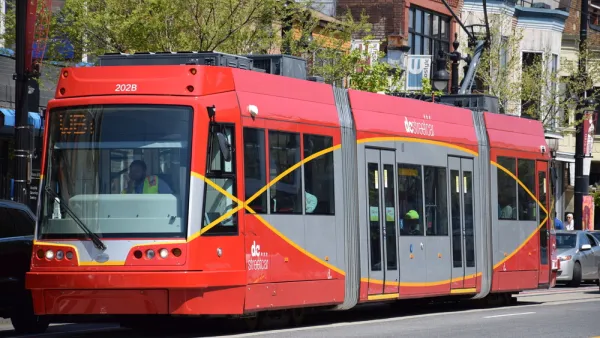
The long-delayed D.C. Streetcar got some very bad news last week, when a panel of industry experts found evidence of construction mistakes that will severely impact the system's reliability.


"The District failed to install underground heaters at key points along its beleaguered streetcar line, allowing snow and ice to freeze up critical switches that are supposed to guide the 35-ton vehicles from one piece of track to another," reports Michael Laris.
That information is one of the findings of a report by an outside experts organized by the American Public Transportation Association.
The lack of switch heaters, as their known, has "broad implications for the reliability of the 2.2-mile line running east of Union Station along H Street and Benning Road NE. During months of test runs last winter, the city’s red-and-gray streetcars were sometimes essentially left frozen in their tracks; workers had to dig out blockages by hand so the vehicles could pass."
The switch heater snafu is only one of the findings of the report. Also included in the damning conclusions of the report: " poor coordination among, and oversight of, contractors; shortcomings with the system’s design; and a variety of safety concerns."
Read the full story: As costs were cut, D.C.’s streetcars were left frozen in tracks
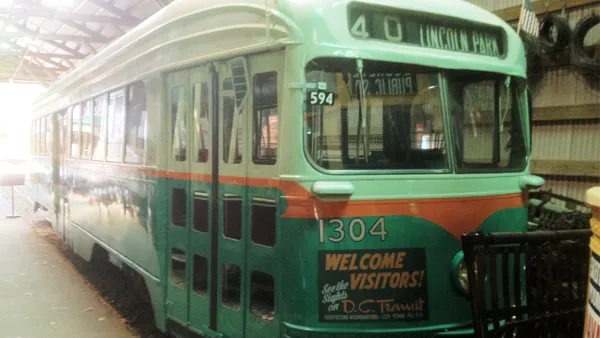
D.C. Officials Dramatically Scale Back Streetcar System
In a recent move, officials from Mayor Vincent C. Gray's administration shortened DC's streetcar system to a much-shorter eight miles.
Delayed, Expensive, and Poorly Planned—D.C. Streetcar Called 'Worse than Nothing'
In January, Washington D.C. Mayor Vincent C. Gray claimed that the district's new streetcar would open in February. Still not open, the D.C. City Council this week slashed future streetcar spending.
A Sneak Peak at D.C.'s Streetcar Extension Plans
With the controversy about the value of its newly opened streetcar ongoing, Washington, D.C. has commenced with a planning process for extending the line to Georgetown.

Planetizen Federal Action Tracker
A weekly monitor of how Trump’s orders and actions are impacting planners and planning in America.

California plans to bury El Niño’s downpour
If the state plays its cards right, it may be able to store a billion acre-feet of El Niño’s water in aquifers.

Desperate measures: Advocates weigh draining Lake Powell to fill Colorado River
Draining the reservoir could reduce evaporation losses by a couple hundred thousand acre-feet.

Los Angeles just elected an urban planner as its mayor
Transportation analysts are optimistic that Raman will be more aggressive in addressing transit issues than Bass.

Mamdani’s pied-à-terre tax survives legal challenge
A panel of judges found that the plaintiffs failed to demonstrate injury as a result of New York City's implementation of the tax.

Eastern Nebraska is running out of electricity
Data centers and electrification are straining eastern Nebraska’s grid, throttling economic development.

FREE Course: Walkable City 1: Why Walkability?
After describing his path towards focusing on walkability as the essence of good planning, Jeff Speck marches through his five principal reasons for making more walkable places.
Reinventing Malls: Planning Alchemy—Turning Gray Fields Into Gold
The course focuses on the opportunities and imperatives that shape reinvention of mall sites.

City of Rosemead
Rutgers University, Edward J. Bloustein School of Planning and Public Policy
One Hundred Miles
University of Michigan School for Environment and Sustainability (SEAS)
Hunter College, City University of New York (CUNY)
The Architects Foundation
City of Cambridge
Montrose County
The Pocatello Development Authority