With the controversy about the value of its newly opened streetcar ongoing, Washington, D.C. has commenced with a planning process for extending the line to Georgetown.


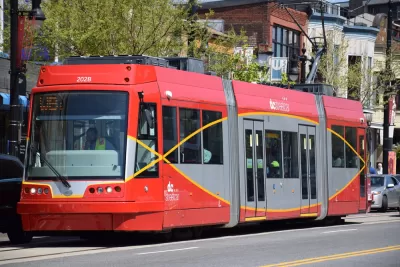
David Alpert provides a sneak peak into the proposed plans for the DC streetcar extension. According to Alpert, "planners from the District Department of Transportation (DDOT) [presented] options to extend the existing H Street streetcar route to Georgetown" this week. In addition to a no-build option, the current plan includes two potential configurations: "one in a dedicated lane from Mount Vernon Square to Washington Circle but in mixed traffic the rest of the way, and a new option to use dedicated lanes for almost the whole length." After opening in February 2016, the D.C. streetcar has been one of the prime talking points in discussions about the value of transit planned to share lane space with automobiles.
The dedicated lane is the result of community feedback, according to Alpert: "more and more people argued that without dedicated lanes, the streetcar would not offer a faster ride, making it no more appealing, transportation-wise, than existing bus lines." The article is also but one in a series that Greater Greater Washington calls a "streetcar mega-feature."
Read the full story: DC's streetcar may go to Georgetown with dedicated lanes
D.C. Streetcar Began Service Saturday (Seriously!)
Yes, this is the real deal. After years of delay and planning and construction mishaps, the long-awaited $200 million, 2.2 mile line streetcar line down H Street began service Saturday. Not all media were kind to the streetcar, even on opening day.
Report: Construction, Management Problems Plague the D.C. Streetcar
The long-delayed D.C. Streetcar got some very bad news last week, when a panel of industry experts found evidence of construction mistakes that will severely impact the system's reliability.
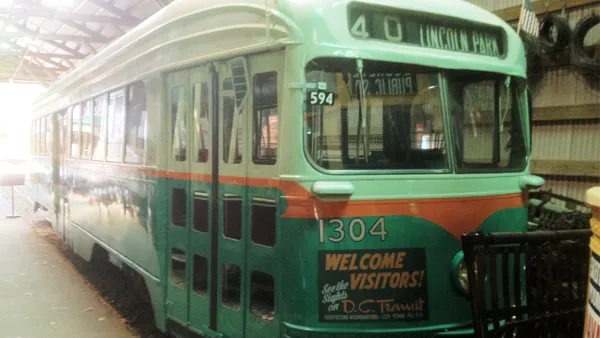
D.C. Officials Dramatically Scale Back Streetcar System
In a recent move, officials from Mayor Vincent C. Gray's administration shortened DC's streetcar system to a much-shorter eight miles.

Planetizen Federal Action Tracker
A weekly monitor of how Trump’s orders and actions are impacting planners and planning in America.

California plans to bury El Niño’s downpour
If the state plays its cards right, it may be able to store a billion acre-feet of El Niño’s water in aquifers.

Desperate measures: Advocates weigh draining Lake Powell to fill Colorado River
Draining the reservoir could reduce evaporation losses by a couple hundred thousand acre-feet.

Los Angeles just elected an urban planner as its mayor
Transportation analysts are optimistic that Raman will be more aggressive in addressing transit issues than Bass.

Mamdani’s pied-à-terre tax survives legal challenge
A panel of judges found that the plaintiffs failed to demonstrate injury as a result of New York City's implementation of the tax.

Eastern Nebraska is running out of electricity
Data centers and electrification are straining eastern Nebraska’s grid, throttling economic development.

FREE Course: Walkable City 1: Why Walkability?
After describing his path towards focusing on walkability as the essence of good planning, Jeff Speck marches through his five principal reasons for making more walkable places.
Reinventing Malls: Planning Alchemy—Turning Gray Fields Into Gold
The course focuses on the opportunities and imperatives that shape reinvention of mall sites.

City of Rosemead
Rutgers University, Edward J. Bloustein School of Planning and Public Policy
One Hundred Miles
University of Michigan School for Environment and Sustainability (SEAS)
Hunter College, City University of New York (CUNY)
The Architects Foundation
City of Cambridge
Montrose County
The Pocatello Development Authority