The Atlantic's Eric Jaffe centers on James Corner's latest work in Cleveland's Public Square, and goes to describe his other well-known projects, including the High Line, and transformations of public parks and urban spaces throughout the country.


"Few people have done more in recent years to breathe life into America’s dead or dying public spaces," writes Jaffe. "Best known for designing the High Line in New York, Corner has been called a landscape 'rock star' and mentioned as a modern successor to Frederick Law Olmsted, the visionary behind Central Park."
Credit: Inhabitat.com
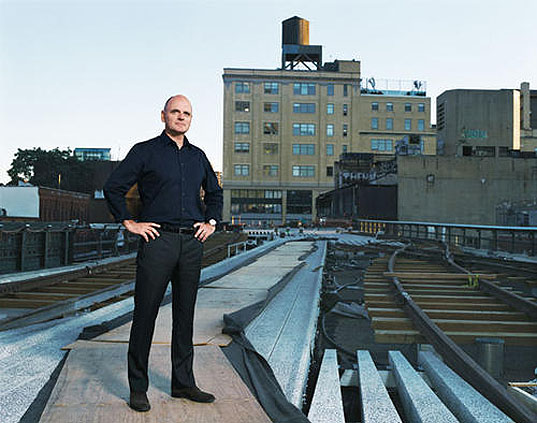
Corner, who hails from just outside industrial Manchester, England, moved to the United States in the 1980s to study urban design at the University of Pennsylvania. As a prime example of his work, many cite not the High Line but Freshkills Park, an ongoing 2,200-acre landfill transformation on Staten Island that began in 2003 and is celebrated for turning a true wasteland into a place that will be not only safe but also attractive to visitors.
Jaffe points to "Santa Monica, San Francisco, Seattle, Brooklyn, Memphis, and Chicago (as) just some of the places that have turned to his practice, James Corner Field Operations, to revive their urban parks." Add redesigning Minneapolis' Nicollet Mall to the list, though Planetizen noted at least one critic of his design for the downtown pedestrian and transit mall.
"City planners are increasingly realizing that investment in public spaces, many neglected for decades, can provide a competitive edge in luring new businesses and residents—especially young creative types—to the urban core," writes Jaffe. Nowhere is that more true than the HIgh LIne - one of the reasons other cities want to replicate its success. Cleveland is no exception, notwithstanding its recent revitalization and downtown population growth.
Public Square “has been our front yard for over a century,” Ann Zoller, the head of land Studio, a local design partner working with Corner’s firm, says. “We really felt that if you had all this development but you still had a dysfunctional Public Square, the city was never going to thrive as it could.”
Jaffe goes on to describe Corner's plans for the historic Public Square that acts as transit hub as well as projects in other cities. "Construction started this spring on Corner’s final design, which is estimated to cost $32 million," he adds.
Planetizen readers may be more familiar with Jaffe's articles that appear in The Atlantic's sister publication, CityLab, that are regularly posted in Planetizen.
Read the full story: Reclaiming the Public Square

Planetizen Federal Action Tracker
A weekly monitor of how Trump’s orders and actions are impacting planners and planning in America.

California plans to bury El Niño’s downpour
If the state plays its cards right, it may be able to store a billion acre-feet of El Niño’s water in aquifers.

Desperate measures: Advocates weigh draining Lake Powell to fill Colorado River
Draining the reservoir could reduce evaporation losses by a couple hundred thousand acre-feet.

Los Angeles just elected an urban planner as its mayor
Transportation analysts are optimistic that Raman will be more aggressive in addressing transit issues than Bass.

Mamdani’s pied-à-terre tax survives legal challenge
A panel of judges found that the plaintiffs failed to demonstrate injury as a result of New York City's implementation of the tax.

Eastern Nebraska is running out of electricity
Data centers and electrification are straining eastern Nebraska’s grid, throttling economic development.

FREE Course: Walkable City 1: Why Walkability?
After describing his path towards focusing on walkability as the essence of good planning, Jeff Speck marches through his five principal reasons for making more walkable places.
Reinventing Malls: Planning Alchemy—Turning Gray Fields Into Gold
The course focuses on the opportunities and imperatives that shape reinvention of mall sites.

City of Rosemead
Rutgers University, Edward J. Bloustein School of Planning and Public Policy
One Hundred Miles
University of Michigan School for Environment and Sustainability (SEAS)
Hunter College, City University of New York (CUNY)
The Architects Foundation
City of Cambridge
Montrose County
The Pocatello Development Authority