Inside the push to speed up the project known as I-4 Ultimate in Central Florida—the $2.3 billion would tear down and rebuild 40 miles of the interstate.


Anjali Fluker reports that U.S. Rep. John Mica (R-Florida) is pushing to move forward with a $2.3 billion "revamp" of Interstate 4 in Central Florida. Namely, Rep. Mica recently "hosted a meeting at the Orlando office of MetroPlan Orlando to discuss with local officials and interested parties how to push ahead on the next $2 billion phase of I-4 Ultimate."
The Florida Department of Transportation (FDOT) is working with HTNB Corps on the study for the project. According to Fluker, the plan is to tear up and rebuild "40 miles of roadway from Kirkman Road in Orange County south to U.S. Highway 27 in Polk County, and from State Road 434 in Seminole County north to State Road 472 in Volusia County." More information on the proposed project is available at the FDOT's 1-4 Express website.
Rep. Mica's idea is to speed up the timeline on the estimated construction start date, from 2025 to "In the next four or five years." Fluker explains the reasoning behind the push: "Traffic congestion may be solved on the parts where the highway is revamped, but the roadways just beyond won’t be ready for that additional rush of vehicles." In Mica's own words, quoted directly in the article: "Once the I-4 Ultimate is done, just close your eyes and imagine four more lanes plus increased traffic pouring in from Kirkman Road in the next four years; you’re looking at a disastrous situation if we don’t do something about it right now…"
Read the full story: Beyond I-4 Ultimate: Mica pushes to start $2B next phase
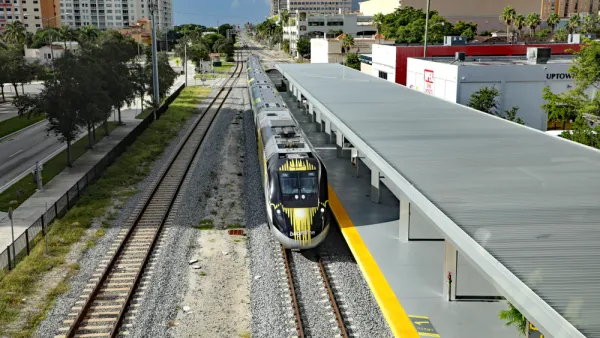
Deadline for Brightline Plan Comes With Strings Attached
Officials from Brightline recently signed an agreement that dictates terms for the study of an extension of the private rail system between Orlando and Tampa.
How Not to Do Growth
The state of Florida is moving forward with the Multi-use Corridors of Regional Economic Significance (M-Cores) plan to build several new toll expressways in rural parts of the state.
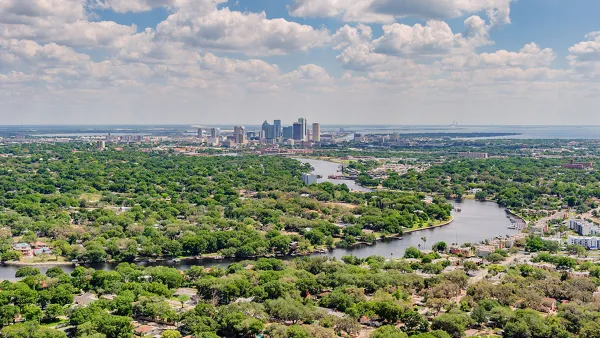
Tampa to Orlando High Speed Rail Back on the Table
Brightline thinks it can build a high speed rail connection between Tampa and Orlando without public money, and Governor Rick Scott looks ready to let them.

Planetizen Federal Action Tracker
A weekly monitor of how Trump’s orders and actions are impacting planners and planning in America.

California plans to bury El Niño’s downpour
If the state plays its cards right, it may be able to store a billion acre-feet of El Niño’s water in aquifers.

Desperate measures: Advocates weigh draining Lake Powell to fill Colorado River
Draining the reservoir could reduce evaporation losses by a couple hundred thousand acre-feet.

Mamdani’s pied-à-terre tax survives legal challenge
A panel of judges found that the plaintiffs failed to demonstrate injury as a result of New York City's implementation of the tax.

Eastern Nebraska is running out of electricity
Data centers and electrification are straining eastern Nebraska’s grid, throttling economic development.

Seattle passes record-breaking transit services expansion
Proposition 1 will double the city’s transit tax to add 95,000 more bus trips and preserve 180,000 bus trips annually.

FREE Course: Walkable City 1: Why Walkability?
After describing his path towards focusing on walkability as the essence of good planning, Jeff Speck marches through his five principal reasons for making more walkable places.
Reinventing Malls: Planning Alchemy—Turning Gray Fields Into Gold
The course focuses on the opportunities and imperatives that shape reinvention of mall sites.

City of Rosemead
Rutgers University, Edward J. Bloustein School of Planning and Public Policy
One Hundred Miles
University of Michigan School for Environment and Sustainability (SEAS)
Hunter College, City University of New York (CUNY)
The Architects Foundation
City of Cambridge
Montrose County
The Pocatello Development Authority