Education, Engineering, and Enforcement. MTA police are taking the last one very seriously at grade crossings they monitor on the Metro-North and LIRR lines since the February crash in Westchester County that killed five passengers and a motorist.


"As a result of the Valhalla [Westchester County] crash, the [Metropolitan Transportation Authority] MTA Police have ramped up their enforcement efforts at railroad crossings in New York City’s suburbs," writes Joseph De Avila, Wall Street Journal's metro reporter for greater New York.
Credit: FHWA Railroad-Highway Grade Crossing Handbook
"The highway unit patrols about 90 railroad crossings for Metro-North and nearly another 300 for the Long Island Rail Road [LIRR]," adds De Avila. Special attention is given to "hot spots" based on "the volume of cars, pedestrians and train traffic."
Judging from the number of summons written, they are indeed serious. "MTA Police issued 326 summons from Jan. 1 to March 30, a marked increase from the 212 issued in all of 2014," he writes.
In fact, he begins his piece describing a motorist being cited who had successfully cleared the descending railroad gate, but who had entered "the area," which he doesn't' specify but presumably is the space before the gates with the large "RXR" stenciled on the asphalt.
Officer Stanton gave the driver a summons for “driving through, under or around a railroad crossing barrier.” A conviction for a first offense is punishable by fines between $250 to $400 and or up to 30 days in jail.
“You shouldn’t be entering that area while lights are flashing and the gates are up or going in the upward or downward motion,” Officer Stanton said in an interview after issuing the summons last month.
While the particular incident that sparked the above ticket was unusual - the gates had lifted after a Metro-North train passed followed by the gates descending before a train going in the opposite direction approached, the citation itself wasn't.
About a third of the 2015 summonses were for driving under or around the gates. The remainder were for other offenses like texting or driving without a seat belt.
A major offense that officers watch for is described as "vehicles obstructing the railroad crossing."
Vehicles obstructing railroad crossings typically occur when a car approaches the crossing but can’t pass completely through because of traffic, Officer Stanton said.
One of my local papers, in describing a horrific crash in February at a Caltrain crossing in Menlo Park, Calif., described this as being "boxed in," implying in my opinion, that it was a freak accident of sorts.
De Avila goes on to describe individual incidents of drivers in Westchester County being cited by Officer Stanton.
The crackdown may have been precipitated in part by local Congresswoman Nita Lowey who has put pressure "on the federal government to bolster education and enforcement campaigns" at grade crossings, according to her Feb. 6 press release.
Hat tip to Heather Caygle of Politico Morning Transportation.
Read the full story: At NYC’s suburban rail crossings, watchful eyes

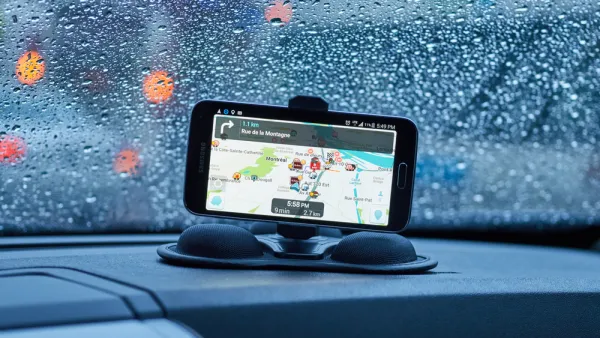
Drivers: Beware Following GPS Navigation Instructions Too Closely
For the second time at the same railroad crossing in Atherton, California, a motorist followed his GPS navigation onto Caltrain tracks. In both cases, the motorists fled their vehicles before being hit by an oncoming train.

Let’s End Traffic Stops
The technology to make traffic enforcement obsolete is becoming available. But in the U.S. willing to use it?
Will GOP Reconsider Redirecting Amtrak Funding After Train Crash?
Republican lawmakers got a first-hand lesson in train safety Wednesday when their chartered Amtrak train hit a trash truck at a grade crossing in Virginia, killing one in the truck. Trump's infrastructure plan redirects Amtrak and transit funding.

Planetizen Federal Action Tracker
A weekly monitor of how Trump’s orders and actions are impacting planners and planning in America.

Amtrak, CN end decades-long dispute with eight-year agreement
The new operating agreement establishes an updated framework for the companies to work together, including processes to resolve disputes.

Judges permit Denver to divert 77,000 acre feet from the Colorado River for reservoir expansion
Overuse and climate change have caused the Colorado River’s water levels to plummet.

NYC DOT wants faster, more permanent street upgrades
The city is examining ways to build more concrete infrastructure without getting entangled in 'decades-long' projects.

'Something we’ve never seen before:' rising utility rates could strain city finances nationwide
Data centers, climate change and other factors have caused utility rates in the United States to increase by 38% since 2020.

Trump to overrule local leaders, lease millions of acres of America’s Pacific Island territories’ seafloors to mining companies
International law says that the Indigenous people of America’s territories have a right to prior and informed consent regarding projects that impact their countries.

FREE Course: Walkable City 1: Why Walkability?
After describing his path towards focusing on walkability as the essence of good planning, Jeff Speck marches through his five principal reasons for making more walkable places.
Reinventing Malls: Planning Alchemy—Turning Gray Fields Into Gold
The course focuses on the opportunities and imperatives that shape reinvention of mall sites.

Harvard University Graduate School of Design
KFH Group Inc.
Greater Baltimore Committee
The Architects Foundation
University of Cincinnati Online
The Pocatello Development Authority
The Urban Renewal Agency of the City of Pocatello