Los Angeles Mayor Eric Garcetti has ambitious plans to modernize the city. This week his administration laid out a sweeping sustainability agenda on matters of critical importance to the future of the nation's second largest city.


"Los Angeles Mayor Eric Garcetti’s office unveiled a sweeping city sustainability plan today that seeks to reduce the amount of imported water used by Angelenos, improve air quality levels and reduce greenhouse emissions over the next two decades," reports Dakota Smith.
Totaling 105 pages, the sustainable city plan—cleverly titled "the pLAn"—sets goals to be measured in 2025 and 2035.
On one measure of extremely current relevance, one of the plan’s most ambitious goals says "Los Angeles would source 50 percent of its water locally by 2035 by turning to recycling, stormwater capture and other conservation methods," according to Smith.
Also, "[t]he plan seeks to have 'zero days' when air pollution reaches unhealthy levels by 2025. The city saw 14 days last year when levels reached unhealthy thresholds…"
Peter Jamison also reported on the release of the pLAn.
Read the full story: Los Angeles Mayor Eric Garcetti releases sustainability plan for city

Cooling L.A.
Changing the color of L.A. streets and growing out the urban canopy are part of a campaign to fight the heat island in and around Los Angeles.
National Attention for the Bold Plan to Reshape Transportation in the City of Angels
Mobility Plan 2035, a visionary plan to get Angelenos out of their cars, attracted the attention of The New York Times. The plan calls for using road diets and transit-only lanes to replace auto trips with bike and bus trips, but many are skeptical.
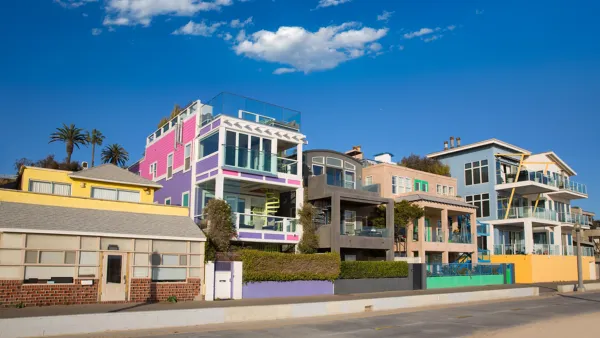
Op-Ed Decries Santa Monica's Airbnb Ban
By exiling short-term renters, the coastal city of Santa Monica shifts its housing burden onto neighboring areas. That burden, according to this op-ed, contradicts the city's sustainability commitment and further limits scarce residential options.

Planetizen Federal Action Tracker
A weekly monitor of how Trump’s orders and actions are impacting planners and planning in America.

California plans to bury El Niño’s downpour
If the state plays its cards right, it may be able to store a billion acre-feet of El Niño’s water in aquifers.

Desperate measures: Advocates weigh draining Lake Powell to fill Colorado River
Draining the reservoir could reduce evaporation losses by a couple hundred thousand acre-feet.

Los Angeles just elected an urban planner as its mayor
Transportation analysts are optimistic that Raman will be more aggressive in addressing transit issues than Bass.

Mamdani’s pied-à-terre tax survives legal challenge
A panel of judges found that the plaintiffs failed to demonstrate injury as a result of New York City's implementation of the tax.

Eastern Nebraska is running out of electricity
Data centers and electrification are straining eastern Nebraska’s grid, throttling economic development.

FREE Course: Walkable City 1: Why Walkability?
After describing his path towards focusing on walkability as the essence of good planning, Jeff Speck marches through his five principal reasons for making more walkable places.
Reinventing Malls: Planning Alchemy—Turning Gray Fields Into Gold
The course focuses on the opportunities and imperatives that shape reinvention of mall sites.

City of Rosemead
Rutgers University, Edward J. Bloustein School of Planning and Public Policy
One Hundred Miles
University of Michigan School for Environment and Sustainability (SEAS)
Hunter College, City University of New York (CUNY)
The Architects Foundation
City of Cambridge
Montrose County
The Pocatello Development Authority