Two academic researchers explain the planning and landscape architecture opportunities offered by the "dramatic fluctuations" and "emergent shorelands" of the Great Lakes Coasts.


Karen Lutsky and Sean Burkholder write about the impact of climate change on coastlines along the Great Lakes. The potential impacts of rising sea levels on cities like New Orleans, Miami, New York City, and San Francisco have been well documented, of course, "[b]ut climatic volatility also affects the Great Lake Coasts," write Lutsky and Burkholder, "where the ice cover last winter was lower than it has been since reliable records began, and the shores are battered by more frequent and more intense storms."
Lutsky and Burkholder acknowledge that the impacts of climate change on the Great Lake Coasts is less predictable and that the tendency could be for planners and environmental managers to view the "cyclically emergent" lands along the Great Lakes Coasts as nuisance zones. But, according to Lutsky and Burkholder, "the very factors that make these lands difficult to appropriate also make them well suited for habitat provision, water quality management, and other beneficial uses."
Read the full story: Emergent Shorelands of the Great Lakes
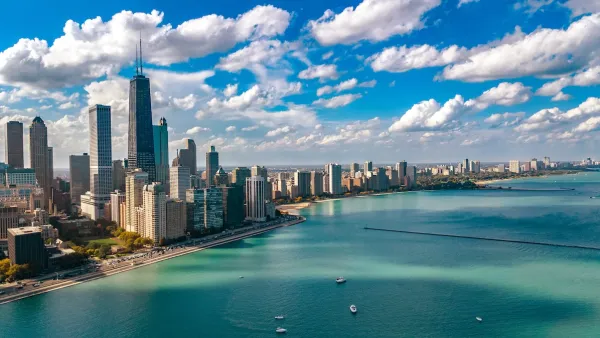
The Great Lakes Cities are Touted as a Climate Refuge. The Reality is Much More Complex.
Sewage overflows, invasive species and polar vortexes — America’s climate haven might be more illusive than we think.
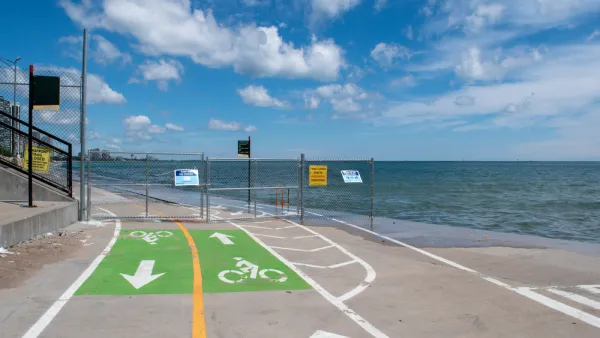
Lessons From the Viral Video of Lake Michigan Taking Out a Bike Commuter
Climate change will only increase the frequency of incidents like the one captured by a television news station in Chicago earlier this week.
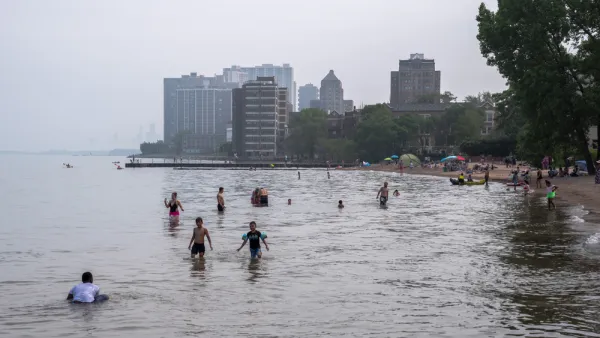
Lake Michigan Continues to Rise, Damaging Property and Infrastructure Along the Way
A tide that began to rise in 2019 hasn't receded, according to local sources along Lake Michigan.

Planetizen Federal Action Tracker
A weekly monitor of how Trump’s orders and actions are impacting planners and planning in America.

Eastern Nebraska is running out of electricity
Data centers and electrification are straining eastern Nebraska’s grid, throttling economic development.

Study reveals best places in the U.S. for cycling, walking
New research from Streetlight Data examines bicycle and pedestrian miles per capita in the 100 largest U.S. cities by population.

DSA members accuse Mamdani of 'abandoning values' over housing redevelopment
New York City's mayor plans to replace about 2,000 units of public housing with private, mixed-income housing.

All sides of BRT debate unhappy with CDOT’s most recent move
The Colorado Department of Transportation is no longer considering center-running bus lanes for Colorado Boulevard.

Massachusetts bogs generate both power, and cranberries
Putting solar panels above farmland is one way Massachusetts is advancing toward its goal of net-zero carbon emissions by 2050.

FREE Course: Walkable City 1: Why Walkability?
After describing his path towards focusing on walkability as the essence of good planning, Jeff Speck marches through his five principal reasons for making more walkable places.
Reinventing Malls: Planning Alchemy—Turning Gray Fields Into Gold
The course focuses on the opportunities and imperatives that shape reinvention of mall sites.

City of Rosemead
Rutgers University, Edward J. Bloustein School of Planning and Public Policy
One Hundred Miles
University of Michigan School for Environment and Sustainability (SEAS)
Hunter College, City University of New York (CUNY)
The Architects Foundation
City of Cambridge
The Pocatello Development Authority
The Urban Renewal Agency of the City of Pocatello