In response to criticisms of the large investments in "big ticket" parks in wealthy neighborhoods during the Bloomberg Administration, New York City announced a park equity plan this week.


Lisa W. Foderaro reports on "an ambitious initiative that would channel some $130 million into tattered parks and playgrounds in low-income neighborhoods across New York City."
The money would benefit a list of 35 parks Foderaro describes as "hardscrabble" and "overlooked during the Bloomberg administration." Here's how Foderaro sums up the reasoning behind the plan: "Under Mr. de Blasio’s plan, 35 of those parks will share the $130 million infusion, plus additional money for maintenance. The parks are all heavily used open spaces in poor neighborhoods that struggle with high obesity and asthma rates. The parks on the list have had little to no investment in recent years."
In a separate article, Scott Heines provides additional details on the proposal, including a list of the 35 parks that stand to benefit from the plan. The proposal, for instance, is not an endorsement of a proposal by state Senator Daniel Squadron to redistribute funds from "well-financed conservancies" to other parts of the city.
Read the full story: 35 New York City Parks to Get Makeovers

Op-Ed: Billionaire Philanthropy Defeats Democratic Process
Following the splashy announcement of media mogul Barry Diller's plans to finance a $170 million park at Manhattan's Pier 54, a New York Times column renews the call for more equity in open space around New York City.
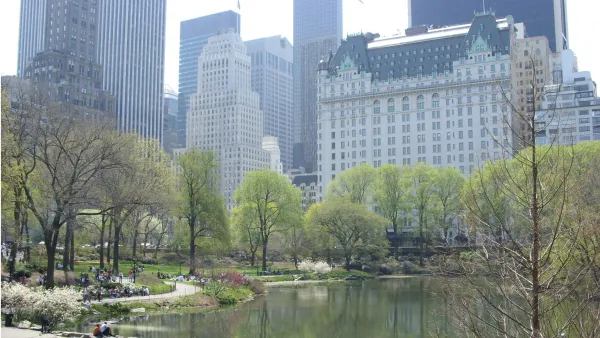
Opinion: Funding for N.Y.C. Parks Should Be a Priority
New York City parks are in desperate need of maintenance and infrastructure improvements, and the city should make investments now to support these essential public spaces.
Report Decries Slow Project Delivery by New York City Parks Department
New Yorkers for Parks released a study earlier this month finding that the Department of Parks and Recreation is one of the city's slowest when it comes to finishing projects on a reasonable timeframe.

Planetizen Federal Action Tracker
A weekly monitor of how Trump’s orders and actions are impacting planners and planning in America.

Amtrak, CN end decades-long dispute with eight-year agreement
The new operating agreement establishes an updated framework for the companies to work together, including processes to resolve disputes.

Northwest rail fans eager for Sept. 30 debut of Amtrak’s Airo fleet
Get ready for that new train smell and more seats. But they won’t go faster or run more frequently on the Cascades route in Washington and Oregon.

St. Louis Metro to test if single-car trains can reduce operating costs, maintain rider satisfaction
The pilot program will run from October to spring 2027, and begin with one single-car train operating on Metrolink’s Red and Blue lines.

Pennsylvania is building data centers in abandoned mines
Housing data centers in mines provides an alternative to destroying local forests and may spare residents from data centers’ noise and air pollution.

If Corpus Christi can’t revive desalination plant project, it may owe Texas $235 million
Earlier this month, city officials declined to pursue developing the plant for the second time in a year.

FREE Course: Walkable City 1: Why Walkability?
After describing his path towards focusing on walkability as the essence of good planning, Jeff Speck marches through his five principal reasons for making more walkable places.
Reinventing Malls: Planning Alchemy—Turning Gray Fields Into Gold
The course focuses on the opportunities and imperatives that shape reinvention of mall sites.

City of Thousand Oaks
City of Wisconsin Rapids
Harvard University Graduate School of Design
The Architects Foundation
University of Cincinnati Online
The Pocatello Development Authority
The Urban Renewal Agency of the City of Pocatello