If the Michigan Department of Transportation (MDOT) approves the order, two Wisconsin-manufactured Talgo train sets will reduce travel times from Detroit to Chicago by as much as two hours while significantly increasing on-time performance.


Editor's note (09/18/2014): a prior version of this post incorrectly indicated that the $58 million for the train sets "comes from President Barack Obama's much maligned High-Speed Rail Strategic Plan of April 2009."
"State transportation officials want to buy two sets of cars and engines, built in the United States by an affiliate of Spanish train maker Talgo Inc.," writes Gary Heinlein of The Detroit News.
If MDOT approves the purchase, $58 million in state funds will be used to purchase the two Talgo train sets "currently sitting idle in Indiana."
Improvements to the corridor will "allow trains to reach 110 miles an hour and, in a few years, get passengers from one city to another two hours faster than they can today," Heinlein adds.
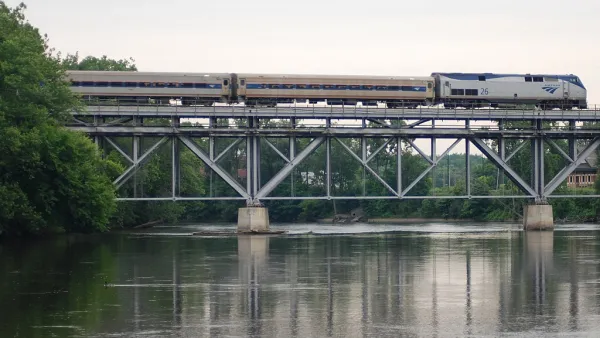
The two Talgo sets will replace 30- to 40-year-old Amtrak cars on two of the three daily Detroit-Chicago runs on the route Amtrak calls The Wolverine. Older cars will continue on the other run until the state buys newer equipment in a couple of years
The train sets were built for Amtrak's Hiawatha route between Milwaukee and Chicago before high speed rail opponent, Gov. Scott Walker (R-Wisconsin) rejected $810 million in federal high speed rail stimulus funds, calling it "a waste of taxpayer money," as other newly elected Republican governors (save Gov. Rick Snyder, R-Mich.) appeared to do in unison.
While MDOT will purchase the Talgo sets if the order is approved, the trains will run on a corridor purchased and improved with two High-Speed Intercity Passenger Rail Program grants:
- $160 million as we noted in Oct. 2010.
- Earlier the state received $196.5 million from that program for track and signal improvements for the Detroit to Kalamazoo corridor, according to Progressive Railroading
The $356.5 million comes from the $2.4 billion in high speed rail stimulus money that Gov. Rick Scott (R-Fla.) rejected in Feb. 2011.
Passenger cars and locomotives manufactured by Siemens Rail Systems USA through the Federal Railroad Administration's "next generation equipment purchase" will eventually be used on the Detroit to Chicago corridor.
[Correspondent's note: Thanks to Michael England of the Federal Railroad Administration for bringing the original error to my attention.]
FULL STORY: Amtrak's Detroit-Chicago trip to get faster, plusher with upgrades

Amtrak Wants to Extend the Wolverine Line With Service From Detroit to Toronto
There hasn't been a passenger rail connection between Detroit and Toronto since 1971, but that could change.
$102 Million Brings Chicago-St. Louis High Speed Rail a Step Closer
A $102 million investment by Illinois along with federal funds from the Recovery Act will pay for double-tracking and a new rail bridge to enable 109 mph service on a key section of Amtrak's Chicago to St. Louis high speed rail corridor.
Wisconsin Rail Upgrade Still Possible
While Gov. Walker's rejection of $810 million of federal stimulus funds for the Milwaukee-Madison rail upgrade has received much publicity, he has not ruled out using funds to upgrade the existing Milwaukee-Chicago Hiawatha Line pushed by businesses.

Planetizen Federal Action Tracker
A weekly monitor of how Trump’s orders and actions are impacting planners and planning in America.

The state-sanctioned urbicide of Austin
People don’t kill cities. Freeways do.

US to reduce Colorado River water deliveries to Mexico
A new Colorado Treaty amendment reduces Mexico’s Colorado River water allocation by 250,000 acre feet.

5 New England states march closer to 800 megawatt wind energy project
Securing federal approval for the project may be complicated under the Trump administration, which has historically been hostile towards domestic wind power.

Baltimore to break ground on $50 million Transit Priority Project
The project will bring faster bus trips, safer streets and better bike connections to Baltimore.

Airbnb launches $250 million 'last-dollar financing' housing accelerator, makes first investment in Austin
The company will put $6.4 million towards affordable housing development in Texas’ capital.

FREE Course: Walkable City 1: Why Walkability?
After describing his path towards focusing on walkability as the essence of good planning, Jeff Speck marches through his five principal reasons for making more walkable places.
Reinventing Malls: Planning Alchemy—Turning Gray Fields Into Gold
The course focuses on the opportunities and imperatives that shape reinvention of mall sites.

Eagle County Government
Harvard University Graduate School of Design
Nashville Planning Department
The Architects Foundation
University of Cincinnati Online
The Pocatello Development Authority
The Urban Renewal Agency of the City of Pocatello
Journal of the American Planning Association