San Francisco Chronicle Architecture Critic John King reviews, and celebrates, the recent string of small projects that reclaim public space in the city, calling them "modest works of true ambition."


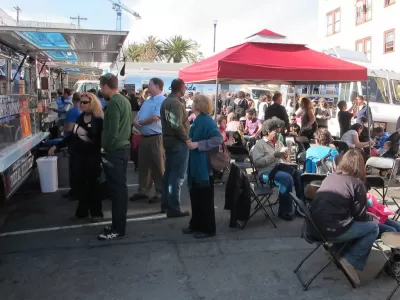
John King introduces the idea at the heart of the article by making the following claim: "the aspirations of a city can also be measured in smaller scraps of land - the remnant spaces that often are blighted or ignored, but with imaginative design and care have the potential to be destinations."
"That's why it is heartening to see San Francisco working to fold scraps back into the public realm, making common ground at the community level. The effort began several years ago; this year's crop includes a remade downtown plaza, stray land from a freeway project and a remote dead end."
King goes on to describe such efforts at locations like Mechanics Plaza on Market Street in the Financial District, three spaces "along and under" the Central Freeway, McCoppin Hub, and Burrows Pocket Park.
Read the full story: S.F.'s uncommon areas: Plazas created from scraps of urban land
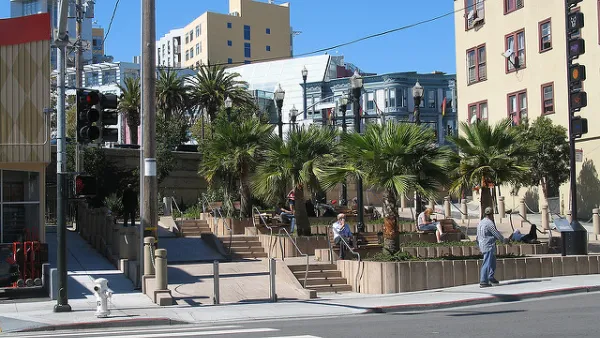
San Francisco Debates an Anti-Homeless Fence
The deployment of so-called defensive architecture is in the news again. This time the controversy is in the public realm, as San Francisco considers a fence to keep homeless out of McCoppin Hub.

San Francisco to Dismantle its Polarizing Brutalist Fountain
The Vaillancourt Fountain stands as a symbol of the tension between the city’s past and future.
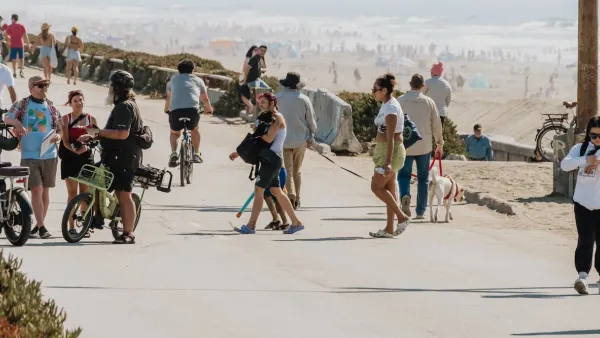
San Francisco Opens Park on Former Great Highway
The Sunset Dunes park’s grand opening attracted both fans and detractors.

Planetizen Federal Action Tracker
A weekly monitor of how Trump’s orders and actions are impacting planners and planning in America.

California plans to bury El Niño’s downpour
If the state plays its cards right, it may be able to store a billion acre-feet of El Niño’s water in aquifers.

Desperate measures: Advocates weigh draining Lake Powell to fill Colorado River
Draining the reservoir could reduce evaporation losses by a couple hundred thousand acre-feet.

Mamdani’s pied-à-terre tax survives legal challenge
A panel of judges found that the plaintiffs failed to demonstrate injury as a result of New York City's implementation of the tax.

Eastern Nebraska is running out of electricity
Data centers and electrification are straining eastern Nebraska’s grid, throttling economic development.

Seattle passes record-breaking transit services expansion
Proposition 1 will double the city’s transit tax to add 95,000 more bus trips and preserve 180,000 bus trips annually.

FREE Course: Walkable City 1: Why Walkability?
After describing his path towards focusing on walkability as the essence of good planning, Jeff Speck marches through his five principal reasons for making more walkable places.
Reinventing Malls: Planning Alchemy—Turning Gray Fields Into Gold
The course focuses on the opportunities and imperatives that shape reinvention of mall sites.

City of Rosemead
Rutgers University, Edward J. Bloustein School of Planning and Public Policy
One Hundred Miles
University of Michigan School for Environment and Sustainability (SEAS)
Hunter College, City University of New York (CUNY)
The Architects Foundation
City of Cambridge
Montrose County
The Pocatello Development Authority