The deployment of so-called defensive architecture is in the news again. This time the controversy is in the public realm, as San Francisco considers a fence to keep homeless out of McCoppin Hub.


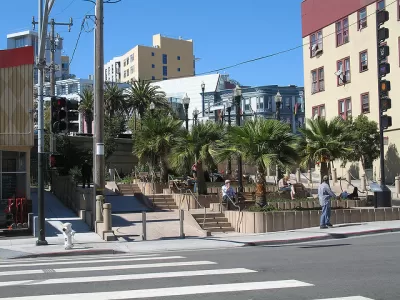
"There are many proposed solutions for the city’s homeless problems: more housing, more treatment, more funding, more tough love," writes Adam Brinklow. "The latest proposal is a fence around a troubled plaza."
The fence in question would go up around McCoppin Hub, a public square near Market and Valencia Street.
Local blogger Michael Petrelis broke the news that McCoppin Hub will be fenced in as an anti-homeless measure by Labor Day.
Brinklow sums up the trouble with using a fence as a deterrent to the homeless:
There would appear to be a built-in contradiction here: If the plaza is a public space, the public should presumably have access to it. "Installing this fence will not only keep the homeless out, it will keep all the rest of us locked outside too," the Sisters of Perpetual Indulgence complained in an online petition circulated last year.
The article also includes a poll to ask readers whether they support the fence. At the time of this writing, 472 respondents have weighed in on the question, with 61 percent saying the fence should go up.
FULL STORY: Poll: Should the City Fence the Homeless Out of Plazas?

The Resurgence of Anti-Homeless Policy and Design
A report by researchers at the University of California, Berkeley tracks the proliferation of vagrancy laws in the Golden State. Meanwhile, The Guardian notes the spread of so-called "defensive architecture."
On the Value of Small Spaces in Remaking the Public Realm
San Francisco Chronicle Architecture Critic John King reviews, and celebrates, the recent string of small projects that reclaim public space in the city, calling them "modest works of true ambition."
Why You Can Never Find a Bench in San Francisco
Over the last two decades the city of San Francisco has systematically removed its public benches to fight homelessness. Now citizens are clamoring for their return.

The state-sanctioned urbicide of Austin
People don’t kill cities. Freeways do.

US to reduce Colorado River water deliveries to Mexico
A new Colorado Treaty amendment reduces Mexico’s Colorado River water allocation by 250,000 acre feet.

New Jersey’s second-largest city bans standalone data centers
Jersey City will continue to allow co-location facilities, such as those meant for research institutions that store their own data.

Amtrak not solely to blame for New Jersey commuter rail's unreliability, report finds
A new study from the Garden State Initiative found that NJ Transit’s budget grew 20% across a 4 year period, but reliability declined significantly over the same period.

EPA erases limits on planet-warming pollution from power plants
Under Monday’s plan, power plants would still have some limits on how much mercury, arsenic and other contaminants they can emit.

Phoenix announces new on-demand transit service, more frequent RAPID buses
Both new services will launch in October, and are part of Phoenix's Project Effective Access Solutions for Easing Congestion.

FREE Course: Walkable City 1: Why Walkability?
After describing his path towards focusing on walkability as the essence of good planning, Jeff Speck marches through his five principal reasons for making more walkable places.
Reinventing Malls: Planning Alchemy—Turning Gray Fields Into Gold
The course focuses on the opportunities and imperatives that shape reinvention of mall sites.

Eagle County Government
Harvard University Graduate School of Design
Nashville Planning Department
The Architects Foundation
University of Cincinnati Online
The Pocatello Development Authority
The Urban Renewal Agency of the City of Pocatello
Journal of the American Planning Association