A study finds that most drivers disregard for the rights of pedestrians to cross the road. Visual cues, however, provided by street design, greatly increase the likelihood that drivers will yield.


"Most drivers tracked in a new Chicago-area survey failed to comply with a state law requiring them to stop for pedestrians, a finding that the research's backers attribute to inadequate police enforcement and education on traffic-safety laws," reports John Hilkevitch.
The study, conducted by the Active Transportation Alliance at 52 locations in Chicago, also found that streets designed to improve pedestrian safety greatly increases the safe practice of drivers.
For sake of comparison, "61 percent of motorists did stop for pedestrians at painted crosswalks that also had other safety features, including in-road "stop for pedestrians'' signs, brick or stone crosswalks, raised crosswalks or flashing beacons"
However, "compliance…was only about 18 percent on average when the pedestrians attempted to cross a street in a traditional painted crosswalk," and "the compliance rate plummeted to almost 5 percent at unmarked crosswalks."
Read the full story: Many drivers ignoring crosswalk law: study
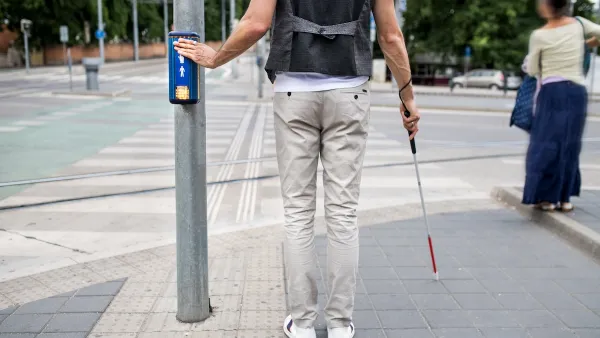
Chicago Judge Orders Thousands of Accessible Ped Signals
Only 3% of the city's crossing signals are currently accessible to blind pedestrians.
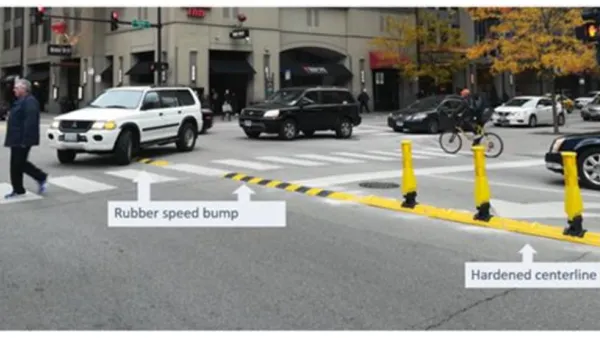
Chicago Left Turn Traffic Calming Reduces Crashes
The city installed reflective posts and speed bumps at dangerous intersections to induce drivers to take left turns more slowly and carefully.
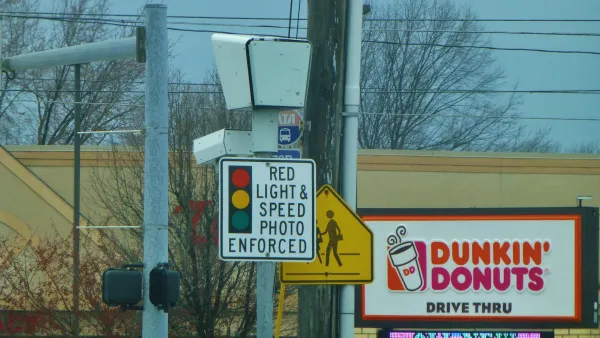
To Protect Pedestrians, Keep the Cameras
Active Transportation Alliance, a Chicago pedestrian advocacy group, urges Mayor Rahm Emanuel to improve red light cameras rather than remove them. Despite complaints from drivers, well-advertised cameras can reduce pedestrian fatalities.

Planetizen Federal Action Tracker
A weekly monitor of how Trump’s orders and actions are impacting planners and planning in America.

California plans to bury El Niño’s downpour
If the state plays its cards right, it may be able to store a billion acre-feet of El Niño’s water in aquifers.

Desperate measures: Advocates weigh draining Lake Powell to fill Colorado River
Draining the reservoir could reduce evaporation losses by a couple hundred thousand acre-feet.

Mamdani’s pied-à-terre tax survives legal challenge
A panel of judges found that the plaintiffs failed to demonstrate injury as a result of New York City's implementation of the tax.

Eastern Nebraska is running out of electricity
Data centers and electrification are straining eastern Nebraska’s grid, throttling economic development.

Seattle passes record-breaking transit services expansion
Proposition 1 will double the city’s transit tax to add 95,000 more bus trips and preserve 180,000 bus trips annually.

FREE Course: Walkable City 1: Why Walkability?
After describing his path towards focusing on walkability as the essence of good planning, Jeff Speck marches through his five principal reasons for making more walkable places.
Reinventing Malls: Planning Alchemy—Turning Gray Fields Into Gold
The course focuses on the opportunities and imperatives that shape reinvention of mall sites.

City of Rosemead
Rutgers University, Edward J. Bloustein School of Planning and Public Policy
One Hundred Miles
University of Michigan School for Environment and Sustainability (SEAS)
Hunter College, City University of New York (CUNY)
The Architects Foundation
City of Cambridge
Montrose County
The Pocatello Development Authority