Josh Brown reports for the Tennessean on the unintended consequences of a fee waiver meant to encourage infill development—developers are readily choosing to pay the fee instead of building sidewalks.


According to Josh Brown, Nashville has had a long history of underbuilding sidewalks, resulting in a legacy of perilous conditions for pedestrians. In fact, "[the] city's 2003 strategic plan for sidewalks and bikeways found that for every three miles of road, there was roughly just a mile of sidewalks."
The article posits, however, "that it's cheaper for builders to pay a fee that waives the requirement to build a sidewalk than it is to construct one." After some 2012 changes meant to encourage infill development, "[the] fee is now a flat rate, depending upon the size of the development, but the most a developer would pay for not building sidewalks is $500 to $1,500."
The article also noted that Nashville ranked as the 15th most dangerous city for pedestrians according to the "Dangerous by Design" pedestrian safety report released in May by Smart Growth America and the National Complete Streets Coalition.
Read the full story: Nashville's lack of sidewalks sparks campaign
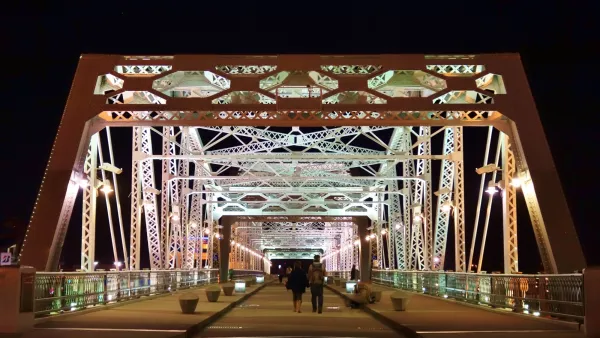
Nashville Releases 5-Year 'WalknBike' Plan
The plan lays out the city's plans for improving its bike infrastructure and sidewalk network.

The number of kids walking to school dropped from over 50% to 11% since the 1960s
Unsafe pedestrian infrastructure makes walking to school dangerous or impossible for a growing number of American students.
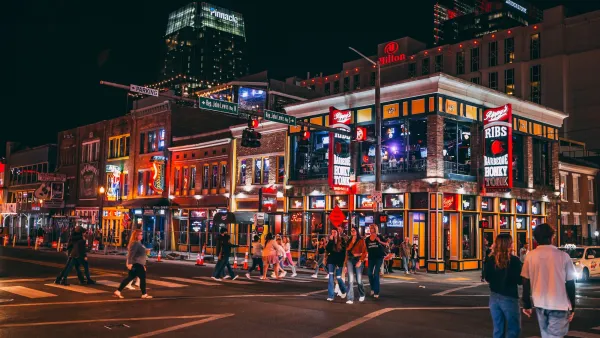
Tennessee DOT weighs making Nashville's Broadway car-free — sometimes
After a crash that killed one person and injured several others, state and city officials are in talks to consider options for closing the popular thoroughfare to cars during certain events.

Planetizen Federal Action Tracker
A weekly monitor of how Trump’s orders and actions are impacting planners and planning in America.

Washington state to charge fee to drivers with fuel-efficient cars
Revenue from the fee will go towards supporting the state’s highways.

Illinois considers spending $1 billion in taxpayer money on data center
A quantum computing campus and data center are currently under construction in Chicago.

Senate passes bill overhauling permitting
The bill still needs to pass the House.

Did data centers change how voters cast their ballots?
Texas, Ohio, and Georgia all flipped party control. But in rural counties, the effect of local data centers was mixed.

Amtrak invests in eight new Airo trainsets
The new trainsets will begin serving passengers in 2031.

FREE Course: Walkable City 1: Why Walkability?
After describing his path towards focusing on walkability as the essence of good planning, Jeff Speck marches through his five principal reasons for making more walkable places.
Reinventing Malls: Planning Alchemy—Turning Gray Fields Into Gold
The course focuses on the opportunities and imperatives that shape reinvention of mall sites.

City of Charlotte
City of Rosemead
Rutgers University, Edward J. Bloustein School of Planning and Public Policy
University of Michigan School for Environment and Sustainability (SEAS)
Hunter College, City University of New York (CUNY)
The Architects Foundation
University District Partnership