In another example of Los Angeles slowly unraveling itself from prior legislation that hinder its transit goals, Governor Jerry Brown signed a bill that will allow light rail construction in the San Fernando Valley.


"Gov. Jerry Brown signed a bill Thursday that will allow the Los Angeles County Metropolitan Transportation Authority to convert the Metro Orange Line to light-rail. Brown's signature reverses a 1991 law that banned above-ground rail through North Hollywood and Van Nuys," reports Laura Nelson.
"Transit advocates said reversing the so-called Robbins Bill, authored by then-state Sen. Alan Robbins (D-Tarzana), is a needed step for the Valley, which is home to just two of Los Angeles County's 80 commuter rail stations. But Metro officials said the hardest work is still ahead."
The plans to build light rail in The Valley can now commence, although any proposal will still require several steps before funding is even considered: "An Orange Line project is not included in the agency's list of short-term priorities, he said, and the route has no additional funding identified in Measure R, the half-cent sales tax for transportation passed by Los Angeles County voters in 2008….But Los Angeles City Councilman and Metro board member Paul Krekorian wants to push ahead immediately. Krekorian plans to ask Metro this month for a feasibility study on how to convert the busway to light-rail, a source with direct knowledge of the situation told The Times."
Read the full story: Brown signs bill lifting ban against light-rail in San Fernando Valley

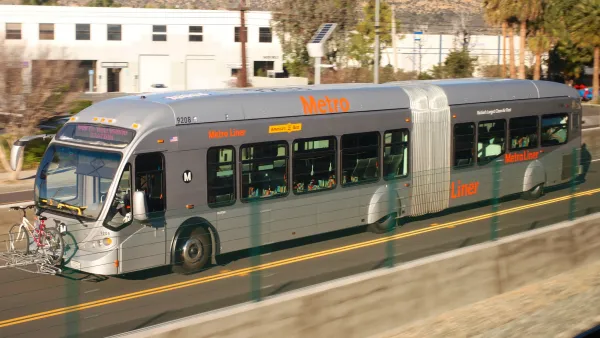
Funding for Two Transit Projects Approved for the Valley in Los Angeles
Local funding for a new light rail line and upgrades to the G Line (née Orange Line) bus rapid transit route have been approved for the San Fernando Valley in Los Angeles.
San Fernando Valley Playing Catch Up in the Los Angeles Transit Boom
Dakota Smith reports that the Los Angeles transit renaissance is leaving the political leadership in the San Fernando Valley feeling left behind.
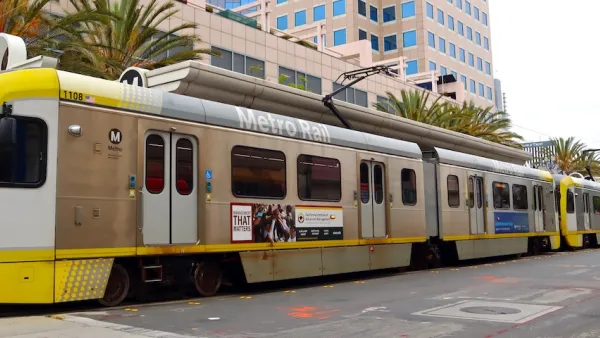
The World’s Longest Light Rail Line is in… Los Angeles?
In a city not known for its public transit, the 48.5-mile A Line is the longest of its kind on the planet.

Planetizen Federal Action Tracker
A weekly monitor of how Trump’s orders and actions are impacting planners and planning in America.

Amtrak, CN end decades-long dispute with eight-year agreement
The new operating agreement establishes an updated framework for the companies to work together, including processes to resolve disputes.

Judges permit Denver to divert 77,000 acre feet from the Colorado River for reservoir expansion
Overuse and climate change have caused the Colorado River’s water levels to plummet.

Idaho may see an 18% drop in federal surface transit funding — the largest estimated cut in the US
Transit systems in rural communities are much more reliant on federal funding to provide their services.

How ‘post-disaster gentrification’ alters neighborhoods after natural calamities
After hurricanes, fires or other calamities, the original residents of a community are often replaced by younger, wealthier residents.

Maryland local governments examine if they should have more power to raise property taxes
Maryland’s housing market is out of reach for the majority of moderate-income residents.

FREE Course: Walkable City 1: Why Walkability?
After describing his path towards focusing on walkability as the essence of good planning, Jeff Speck marches through his five principal reasons for making more walkable places.
Reinventing Malls: Planning Alchemy—Turning Gray Fields Into Gold
The course focuses on the opportunities and imperatives that shape reinvention of mall sites.

Harvard University Graduate School of Design
KFH Group Inc.
Greater Baltimore Committee
The Architects Foundation
University of Cincinnati Online
The Pocatello Development Authority
The Urban Renewal Agency of the City of Pocatello