Pittsburgh leads all American cities in the number of its public stairways (followed by Los Angeles, Seattle, and San Francisco), but the city has begun removing some of the staircases, citing the high cost of maintenance and public safety.


John Miller reports on the concern of Pittsburgh residents who want to preserve the city's vast network of public staircases while the city is removing steps that are "falling apart, rarely used and costly to maintain."
"The city has just $200,000 for step maintenance in its $52 million budget and it can cost $100,000 just to repair one set of steps," reports Miller. The city has already begun removing stairways, although the city's count of staircases differs from the count of Bob Regan, who wrote the book (The Steps of Pittsburgh) on Pittsburgh's staircases: "the city has roughly 675 public staircases, down from the 712 listed in Mr. Regan's book, and Pittsburgh still needs to get rid of a few more. Mr. Regan disagrees, saying he has now counted 739."
Read the full story: In Pittsburgh, Residents Are Divided on What to Do About Famous Staircases
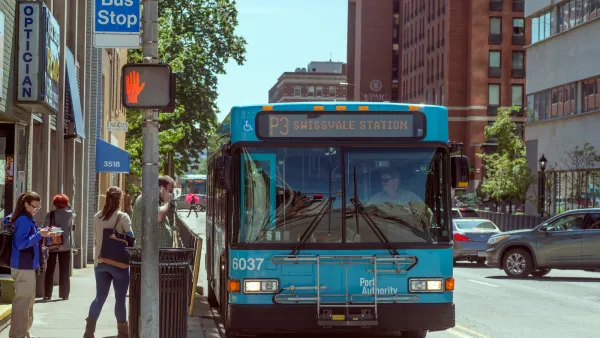
750 Pittsburgh city workers to get free transit passes
City employees working downtown will have access to free transit from Pittsburgh Regional Transit.
Pittsburgh downtown tax diversion plan draws criticism for lack of transparency
A proposed new development tax faces opposition from transit advocates.

Pittsburgh Median Home Price is Lowest in the US at $250K
After the collapse of the U.S. steel industry, the city was left with a glut of affordable homes.

Planetizen Federal Action Tracker
A weekly monitor of how Trump’s orders and actions are impacting planners and planning in America.

California plans to bury El Niño’s downpour
If the state plays its cards right, it may be able to store a billion acre-feet of El Niño’s water in aquifers.

Desperate measures: Advocates weigh draining Lake Powell to fill Colorado River
Draining the reservoir could reduce evaporation losses by a couple hundred thousand acre-feet.

In Texas, data centers are swallowing promised parkland
Residents who moved to Taylor, Texas for a rural community now have to contend with three data centers in their backyard.

How a Chicago-sized wind farm beat the odds and powered on
The project spanned five presidential administrations and a standoff with a U.S. military base.

MTA gives itself 30 days to transform pit into basketball court
The site has been under construction since 2022; the city originally estimated it would finish the court in 2024.

FREE Course: Walkable City 1: Why Walkability?
After describing his path towards focusing on walkability as the essence of good planning, Jeff Speck marches through his five principal reasons for making more walkable places.
Reinventing Malls: Planning Alchemy—Turning Gray Fields Into Gold
The course focuses on the opportunities and imperatives that shape reinvention of mall sites.

City of Rosemead
Rutgers University, Edward J. Bloustein School of Planning and Public Policy
One Hundred Miles
Hunter College, City University of New York (CUNY)
The Architects Foundation
University of Cincinnati Online
City of Cambridge
Montrose County
The Pocatello Development Authority