The 12-cent indexed gas tax hike isn't even a formal bill, yet it's making waves in a Republican Congressional primary in Sen. Bob Corker's home state of Tennessee. One candidate challenged another to take a position on it.


Will supporting the bipartisan tax plan be the death knell for a Republican, particularly one engaged in a primary battle?
"U.S. Rep. Scott DesJarlais today (June 19) questioned whether his GOP primary rival, state Sen Jim Tracy, would support U.S. Sen. Bob Corker’s proposed plan to raise the gas tax by tying it to inflation," writes Andy Sher.
Tracy's candidacy webpage boasts of his conservative endorsements. Many conservative groups like Club for Growth and The Heritage Foundation oppose any increase in the gas tax, preferring a devolution approach to federal transportation finance. [See below].
DesJarlais is essentially playing the "he'll increase your gas taxes" card on his opponent, noting that "Tracy introduced similar legislation that would increase Tennessee's gasoline tax by also basing it on the CPI," though he "never brought the bill up in the Senate committee."
Tracy's response: "Under Jim's leadership there have been NO gas tax increases," states his campaign manager.
Asked (by the Knoxville News Sentinel) if he backed the concept of indexing, Tracy was quoted saying road building costs had increased some 40 percent while Tennessee transportation revenues remained flat.
Tennessee's gas tax, 21.40 cents, is the nation's 38th lowest [PDF]. Most unusually, it's diesel tax is three cents lower. The gas tax hasn't been raised in 25 years.
Judging by the defensive responses by Tracy, Corker may have a difficult time selling his Republican colleagues in the U.S. Senate on his bipartisan plan to keep roads and transit funded, particularly if they are challenged in primaries.
While DesJarlais has indicated his own position on federal transportation finance, if he takes a cue from the Club for Growth, he'll advocate for "devolution, in which money and decisions about spending it would be given to state and local governments," writes Ashley Halsey III in The Washington Post.
"Rather than perpetuate this failed system (of funding from federal gas taxes), Congress should devolve highway funding to the states and let them fund their own infrastructure needs,” said Chris Chocola, the group’s president. [See his video and prior post here describing a devolution bill.]
Heritage Foundation's Emily J. Goff explains devolution in "opposing view" for USA Today.
Read the full story: DesJarlais questions whether GOP primary foe Tracy would back Corker's proposed tax increase
Campaign 2014: Rolling Back Gas Tax Indexing
Massachusetts voters will decide on Question 1 on Tuesday—an initiative petition to eliminate the automatic, annual indexing of its 26.5-cent gasoline excise tax to inflation, implemented with a three-cent gas tax increase last year.
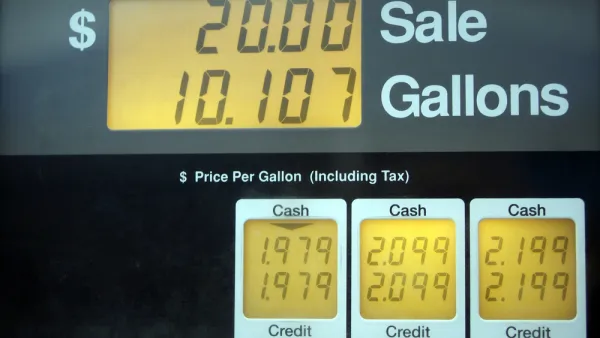
Three States Hope to Take Advantage of Low Gas Prices to Boost Gas Taxes
A movement at the state and federal levels would take advantage of low oil prices to boost gas taxes to pay for infrastructure. Michigan, Iowa, and Utah proposals, and a change to the federal Corker-Murphy plan, are described below.
A Transportation Funding Bill Named for the Tea Party
Make that a 'defunding' bill, technically described as a devolution bill. The concept is simple: roll back the federal gas tax to 3.7 cents per gallon, shift transportation responsibility to the states and use block grants to provide federal funding.

Planetizen Federal Action Tracker
A weekly monitor of how Trump’s orders and actions are impacting planners and planning in America.

California plans to bury El Niño’s downpour
If the state plays its cards right, it may be able to store a billion acre-feet of El Niño’s water in aquifers.

Desperate measures: Advocates weigh draining Lake Powell to fill Colorado River
Draining the reservoir could reduce evaporation losses by a couple hundred thousand acre-feet.

Housing is the top priority of Seattle’s sole new councilmember
Jenks campaigned on building 1,000 new units of affordable housing.

New tax cuts may slash $1.5 billion in funding for Miami transit, public parks
Amendment 3 will save Miami-Dade homeowners $2,700 in 2028.

Arizona, Wisconsin, Pennsylvania hope to finally advance climate goals post-midterms
The three states have spent years under Republican or divided control.

FREE Course: Walkable City 1: Why Walkability?
After describing his path towards focusing on walkability as the essence of good planning, Jeff Speck marches through his five principal reasons for making more walkable places.
Reinventing Malls: Planning Alchemy—Turning Gray Fields Into Gold
The course focuses on the opportunities and imperatives that shape reinvention of mall sites.

City of Rosemead
Rutgers University, Edward J. Bloustein School of Planning and Public Policy
One Hundred Miles
University of Michigan School for Environment and Sustainability (SEAS)
Hunter College, City University of New York (CUNY)
The Architects Foundation
City of Cambridge
Montrose County
The Pocatello Development Authority