Andrew Keatts interviews Benjamin Ross, of Maryland's Purple Line advocacy fame, about what it takes to build local support for transit and urban design.


The interview is in connection to the release of Ross' new book, Dead End: Suburban Sprawl and the Rebirth of American Urbanism, which, according to Ross, addresses the great contemporary dilemma: "Everyone loves these neighborhoods that were built 100 years ago, with thin streets, and houses close together and buildings of different sizes close together, and yet we’re not able to build those things now. I’m trying to figure out why, and why it’s so hard to build transit."
The interview examines the lack of political action by those who support transit compared to opposition forces, including this insight from Ross about the NIMBY movements of today compared to yesteryear: "I think there’s very strong overlap from the NIMBY left and the NIMBY right. What I see is, the NIMBY left is really weakening, because smart growth has become such an important part of environmentalism. Look at Berkeley, where you have these big battles but the pro-development person is this former radical leftist, and you see the same thing in other places. The NIMBY left is much more interesting to write about, even though the NIMBY right is much more important in the grand scheme of things."
Read the full story: ‘The NIMBY Left and NIMBY Right Are Converging’

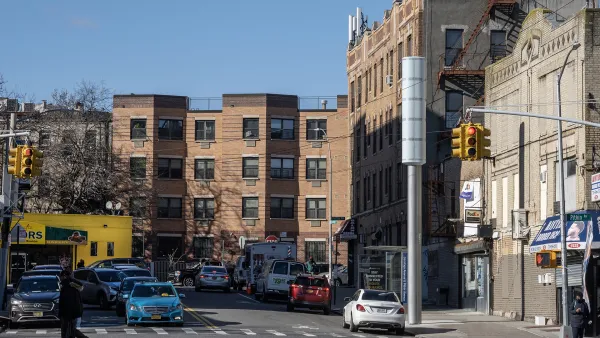
NYC's Link5G Towers Face Neighborhood Opposition
More than 2,000 32-foot towers are coming to New York City street corners to improve 5G connectivity throughout the city, and residents aren’t happy, citing incompatible design and visual distraction as a threat to safety.

Montana Land Use Reform Overhauls Public Participation Rules
In a bid to streamline housing permits, new state legislation limits public input to the land use planning stage.

Converting Golf Courses to Housing Never as Easy as the Market Would Like
Thousands of golf courses have closed in recent years, but the obvious redevelopment opportunity represented by many defunct courses isn’t always easy to realize.

Planetizen Federal Action Tracker
A weekly monitor of how Trump’s orders and actions are impacting planners and planning in America.

‘Going backwards:’ Baltimore mayor, students rally against state's transit funding plan
Maryland's proposed six-year plan provides no funding for Baltimore’s BMORE bus program and reduces its road maintenance funding.

Detroit to transform waterfront with $2.2 billion investment
Developers will convert about 18 acres of unused parking lot space into civic spaces.

U.S.-Iran war may have ‘devastating’ impact on cost to warm homes
Vermont and Maine residents may see a 76% increase in the cost of warming their homes this winter.

Senate bill would ‘overhaul’ environmental permitting laws
Under the proposed act, government agencies would also not be able to suspend or rescind permits after granting them.

Exemption applications for NYC’s pied-à-terre tax see 55% success rate
The city sent nearly 40% of its initial pied-à-terre tax warnings erroneously.

FREE Course: Walkable City 1: Why Walkability?
After describing his path towards focusing on walkability as the essence of good planning, Jeff Speck marches through his five principal reasons for making more walkable places.
Reinventing Malls: Planning Alchemy—Turning Gray Fields Into Gold
The course focuses on the opportunities and imperatives that shape reinvention of mall sites.

One Hundred Miles
County of Mendocino
planning NEXT
The Architects Foundation
University of Cincinnati Online
Montrose County
Northern Illinois Transit Authority (NITA)
The Pocatello Development Authority