First floated as a redevelopment strategy in 2007, Detroit's gamble on casinos has yielded a mature market. Now come reports that even a big name investor hasn't been able to turn around the Greektown Casino.


"Analysts say Detroit’s gaming market is saturated, with increased competition from new Ohio casinos and aging patrons who are choosing to entertain themselves in other ways — all of which contribute to leaner bottom lines for casino operators," reports Michael Martinez.
Quicken Loans founder and CEO Dan Gilbert bought majority interest in the struggling Greektown Casino-Hotel in April 2013, stating plans for a $150 million renovation. According to filings with the Securities and Exchange Commission and reported by Martinez, however, Gilbert has scaled back the renovation to $25-50 million.
The scaled back renovation plans reflect deflating revenues at all three of Detroit's casinos (local gaming revenue is on pace for a third-consecutive year of decline): "Last year, Greektown’s revenue fell the sharpest of Detroit’s three casinos, down 6.7 percent, to $328.3 million. By comparison, revenue dipped 6.3 percent in 2013 at MGM Grand and 1.2 percent percent [sic] at MotorCity."
Read the full story: Greektown Casino scales back renovation plans amid revenue slide


Detroit to transform waterfront with $2.2 billion investment
Developers will convert about 18 acres of unused parking lot space into civic spaces.
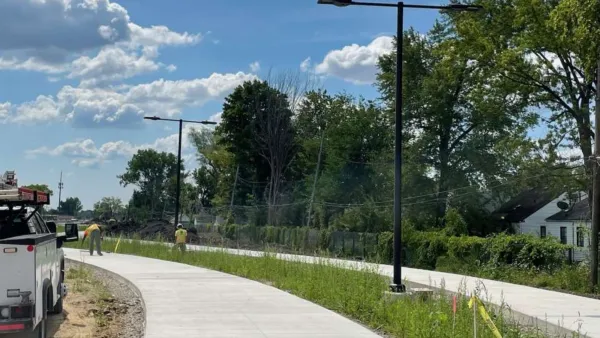
Detroit greenway brings revival — and fears of displacement
The planned Joe Louis Greenway is already bringing change to the neighborhoods near it.

Some Detroit residents spend as much as 25% of their disposable income on water bills. A fraught history explains why.
Detroit’s water affordability crisis is tied to the uneven distribution of stormwater management costs.

Planetizen Federal Action Tracker
A weekly monitor of how Trump’s orders and actions are impacting planners and planning in America.

‘Going backwards:’ Baltimore mayor, students rally against state's transit funding plan
Maryland's proposed six-year plan provides no funding for Baltimore’s BMORE bus program and reduces its road maintenance funding.
Detroit to transform waterfront with $2.2 billion investment
Developers will convert about 18 acres of unused parking lot space into civic spaces.

U.S.-Iran war may have ‘devastating’ impact on cost to warm homes
Vermont and Maine residents may see a 76% increase in the cost of warming their homes this winter.

Senate bill would ‘overhaul’ environmental permitting laws
Under the proposed act, government agencies would also not be able to suspend or rescind permits after granting them.

Exemption applications for NYC’s pied-à-terre tax see 55% success rate
The city sent nearly 40% of its initial pied-à-terre tax warnings erroneously.

FREE Course: Walkable City 1: Why Walkability?
After describing his path towards focusing on walkability as the essence of good planning, Jeff Speck marches through his five principal reasons for making more walkable places.
Reinventing Malls: Planning Alchemy—Turning Gray Fields Into Gold
The course focuses on the opportunities and imperatives that shape reinvention of mall sites.

One Hundred Miles
County of Mendocino
planning NEXT
The Architects Foundation
University of Cincinnati Online
Montrose County
Northern Illinois Transit Authority (NITA)
The Pocatello Development Authority