Reports from Beijing are that Chinese officials are considering a high speed rail project that would connect China to North America. The project sounds like science fiction—but the question remains whether China would or could pull off the project.


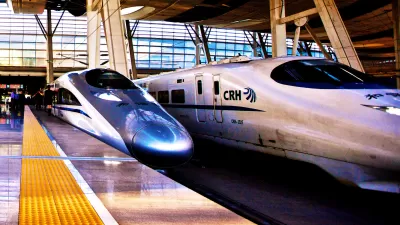
"China is considering building a high-speed railway across the Siberia and Bering Strait to Alaska, across Canada to the US," according to an article in China Daily. The consideration were made public in a Beijing Times article citing Wang Mengshu, a railway expert and academician of the Chinese Academy of Engineering.
"The proposed journey will start from China's northeast region, cross Siberia to Bering Strait, and run across the Pacific Ocean by undersea tunnel to reach Alaska, from Alaska to Canada, then on to its final destination, the US. To cross Bering Strait will require approximately 200km undersea tunnel, the technology, which is already in place will also be used on Fujian to Taiwan high-speed railway tunnel."
Lily Kuo provides some additional analysis of the news, including a cost comparison that estimates the cost of such a route to be somewhere in the neighborhood of $200 billion—if it were to become a reality. Kuo's take: "China may be one of the best examples of countries that love mega-infrastructure projects, but even this may be too much."
Read the full story: China mulls high-speed train to US: report
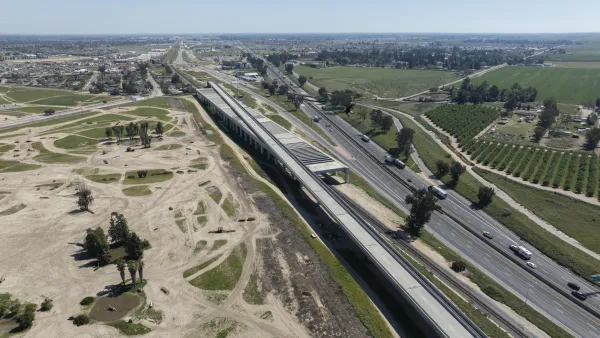
California High-Speed Rail Authority could be broke by the end of 2027
A report from the Office of Inspector General says the authority must borrow against state infusions to stay afloat.
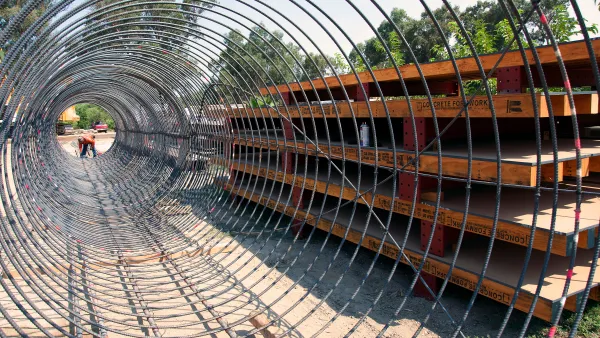
California High Speed Rail to lay first tracks
High Speed Rail Authority officials describe the milestone as "the moment this project truly begins to become a railroad."
TOD Opportunities Around America's First True High-Speed Rail Line
Brightline West hopes to break ground, in anticipation of a 2027 opening. Cities in the Inland Empire and High Desert areas of Southern California are looking to take advantage.

Planetizen Federal Action Tracker
A weekly monitor of how Trump’s orders and actions are impacting planners and planning in America.

Eastern Nebraska is running out of electricity
Data centers and electrification are straining eastern Nebraska’s grid, throttling economic development.

California High-Speed Rail Authority picks trainset manufacturer
The California High-Speed Rail Authority aims to start servicing passengers by 2033.

What could the future of LA transit look like under Raman?
The mayor-elect views broken sidewalks and potholes as crises that can be fixed with better governance.

States are counting on battery farms. Some towns don’t want them.
While fire safety has improved, some communities are still wary.

Dallas releases zoning code overhaul to officials
The drafted overhaul is over 400 pages long.

FREE Course: Walkable City 1: Why Walkability?
After describing his path towards focusing on walkability as the essence of good planning, Jeff Speck marches through his five principal reasons for making more walkable places.
Reinventing Malls: Planning Alchemy—Turning Gray Fields Into Gold
The course focuses on the opportunities and imperatives that shape reinvention of mall sites.

City of Rosemead
Rutgers University, Edward J. Bloustein School of Planning and Public Policy
One Hundred Miles
University of Michigan School for Environment and Sustainability (SEAS)
Hunter College, City University of New York (CUNY)
The Architects Foundation
City of Cambridge
The Pocatello Development Authority
The Urban Renewal Agency of the City of Pocatello