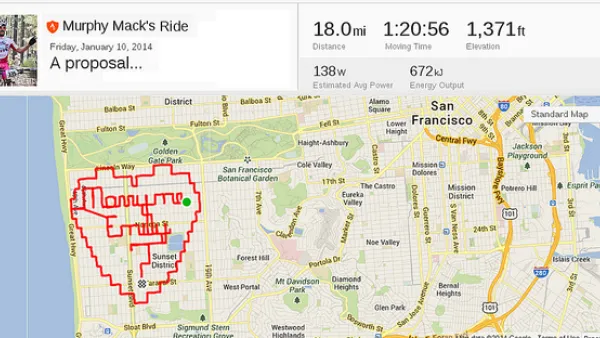
The same week that the New York Police Department released a boat load of data about traffic collisions comes news that exercise app Strava will sell its data on the how, where, and when bikers and runners use streets.


"On Wednesday, the San Francisco-based company launched Strava Metro, which provides data from 90 million bike rides and 24 million runs as of this week — the byproduct of virtual competitions around the world — to help urban planners understand how and where cyclists use public streets," reports Reed Albergotti.
"The first customer, Oregon’s Department of Transportation, is paying $20,000 to use the data for a year. Strava also signed up London; Glasgow; Orlando, Fla.; and Alpine Shire in Victoria, Australia."
Albergotti cites an anecdote shared by Margi Bradway, a policy analyst for the Oregon DOT, who discovered that her friends would use the app even more if they knew planners were using it to make data-driven decisions. In fact, "[in] the past six months, Oregon has used the Strava data to determine where cyclists have trouble figuring out traffic patterns, and to find the best way to install rumble strips on a road outside Portland that is popular with cyclists."
Read the full story: Strava, Popular With Cyclists and Runners, Wants to Sell Its Data to Urban Planners
Fitness Apps Are the New Planning Tool
Many smartphone users have a fitness app that they use to track their routes and progress on fitness goals. The data in these apps is a gold mine for planners, helping lead to better infrastructure investments.
There's No App for Silver Bullets
Two planning researchers, one a professor at Tufts and another independent, make the case against apps as a panacea for urban problems.
Transitmix Finds Professional Applications, Municipal Partners
Transitmix, an online tool for sketching out and testing fantasy transit routes, has evolved beyond its original mass appeal to become a trusted tool for transportation planners around the country.

Desperate measures: Advocates weigh draining Lake Powell to fill Colorado River
Draining the reservoir could reduce evaporation losses by a couple hundred thousand acre-feet.

Eastern Nebraska is running out of electricity
Data centers and electrification are straining eastern Nebraska’s grid, throttling economic development.

Malls are becoming the midtowns of the future
Mall and office park redevelopments are a generational opportunity to create new nodes of urbanity.

NYC breaks ground on anti-flooding infrastructure project
New York City's new system will reduce stormwater flows to local sewers by 90%.

One Kentucky town’s secret to affordable housing
The Smoketown Community Land Trust has already built seven affordable homes for community members.

Houston gains petal-shaped cooling infrastructure to make streets more ‘delightful’
The city has installed the pavilions along 15 blocks in Houston.

FREE Course: Walkable City 1: Why Walkability?
After describing his path towards focusing on walkability as the essence of good planning, Jeff Speck marches through his five principal reasons for making more walkable places.
Reinventing Malls: Planning Alchemy—Turning Gray Fields Into Gold
The course focuses on the opportunities and imperatives that shape reinvention of mall sites.

City of Rosemead
Rutgers University, Edward J. Bloustein School of Planning and Public Policy
One Hundred Miles
University of Michigan School for Environment and Sustainability (SEAS)
Hunter College, City University of New York (CUNY)
The Architects Foundation
City of Cambridge
Montrose County
The Pocatello Development Authority