A new animated map presents the reported cases of potholes in Chicago since November—the maps colorful and provides insights into how the city, and our relationship to it, can change with time.


Vikki Ortiz Healy reports for the Chicago Tribune about a new animated map of pothole reports from November to this week in the city of Chicago. To create the map, Elliott Ramos downloaded data from the city of Chicago’s website, “which meticulously documents all pothole reports.”
The map blinks like a Christmas tree as the number and density of reported potholes expands and contracts with time. January through February, for instance, might require sunglasses for viewing given the density of reported potholes.
According to Healy’s article, Ramos created the visualization to help residents understand the nuances of how data manifests around the city. “At a wide glance, Ramos’ map, which took him less than an hour to create, shows an orange dot for each pothole report. The orange fades to yellow/pink as time elapses. The point, he said, is to demonstrate how the number of pothole reports changes over time, and that there can be days with a surge of reportings — such as just after Jan. 1 or at Jan. 15 — perhaps when more people are home to notice or are inspired by media reports,” writes Healy.
Read the full story: Where are the most pot holes in the city? There's an app for that.

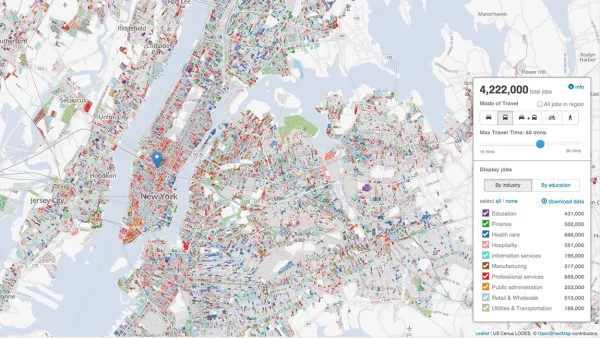
A Central Hub for Open Data
Designed by researchers at the University of Chicago, the Plenario platform gathers all available open data for a specific area. Then it presents the data in an easy-to-use format.
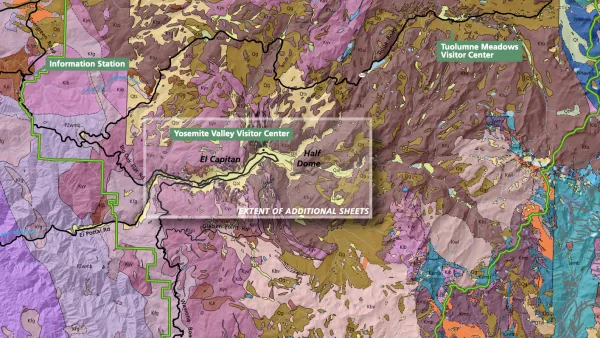
The Growing Importance of Location Intelligence
Location intelligence is transforming decision-making, with an increasing number and type of organizations modernizing operations with a geographic approach to problem-solving, planning, and prediction.
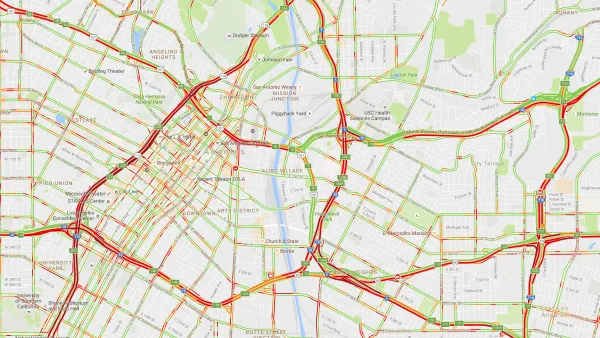
Real-Time Art Installation Reveals the Many Dimensions of Data
Using a wagon filled with phones, an artist in Berlin demonstrated the disconnect between data and the real world.

Planetizen Federal Action Tracker
A weekly monitor of how Trump’s orders and actions are impacting planners and planning in America.

Amtrak, CN end decades-long dispute with eight-year agreement
The new operating agreement establishes an updated framework for the companies to work together, including processes to resolve disputes.

Judges permit Denver to divert 77,000 acre feet from the Colorado River for reservoir expansion
Overuse and climate change have caused the Colorado River’s water levels to plummet.

Boston has spent millions making the Green Line more accessible — and there’s no end in sight
While the city has invested millions into expanding and adding platforms to the Green Line to make it more accessible, new train cars set to arrive next year will be too tall for disabled passengers to board without raising the current platforms.

Idaho may see an 18% drop in federal surface transit funding — the largest estimated cut in the US
Transit systems in rural communities are much more reliant on federal funding to provide their services.

How ‘post-disaster gentrification’ alters neighborhoods after natural calamities
After hurricanes, fires or other calamities, the original residents of a community are often replaced by younger, wealthier residents.

FREE Course: Walkable City 1: Why Walkability?
After describing his path towards focusing on walkability as the essence of good planning, Jeff Speck marches through his five principal reasons for making more walkable places.
Reinventing Malls: Planning Alchemy—Turning Gray Fields Into Gold
The course focuses on the opportunities and imperatives that shape reinvention of mall sites.

City of Wisconsin Rapids
Harvard University Graduate School of Design
KFH Group Inc.
The Architects Foundation
University of Cincinnati Online
The Pocatello Development Authority
The Urban Renewal Agency of the City of Pocatello