When it comes to fracking, much dialog is about energy vs. environment. Not this one. NPR reports on the economic consequences of Europe's rejection of fracking. Many European companies are setting up shop in the U.S. where energy may cost 75% less.


"Much of Europe opposes or even outright bans the process known as fracking, which releases natural gas from shale deposits. Analysts say the failure to develop a shale gas industry is hurting Europe's competitiveness and many companies are moving their operations to the United States," states NPR's Morning Edition host, David Green in the introduction to this radio report (listen here). "This influx of business may be good for the U.S., but it's cause for concern for European leaders."
NPR's foreign affairs correspondent, Jackie Northam traveled to Louisiana to tour a new chemical plant that is "part of an expansion by the German chemical giant BASF." Northam explains that what's driving this expansion, as well as other construction throughout Louisiana and other parts of the U.S. since 2009 "is an abundance of cheap natural gas. ...That's when the shale gas industry took off, thanks, in large part, to hydraulic fracturing or fracking."
A BASF executive at the site tells Northam that their $6 billion investment in 100 production sites across the U.S. since 2009 has "made us globally more competitive from a manufacturing chemical standpoint."
Northam speaks next with "John Larson, a vice president with IHS, a global energy research company, (who) says one of their recent studies found an estimated $100 billion will be pumped into the U.S. economy by 2020 as a result of the low energy prices.
"I would characterize it as a slow deinvestment (sic) in Europe as companies overseas look to seize this opportunity and shift more of their investment dollars to U.S. markets. And, in fact, in Germany, for example, over the past six years, there's been a de-investment of about 52 billion euros," he states.
While NPR didn't discuss the environment in this report, we will as "high energy costs and declining economic competiveness" was the topic of a recent post on Europe. We noted that both factors contributed to "Europe Loosening Their Climate Commitments", thus increasing their carbon emissions. A high environmental price to pay on top of the economic ones for opposing advanced energy extraction technology.
Notwithstanding the economic (or climate target) consequences, "European leaders will face a hard time selling it to a public which widely opposes fracking," states Larson to end the report.
For a well-reasoned arguement to the contrary, read Daniel Gros, Director of the Centre for European Policy Studies, inEuropeanVoice.
Read the full story: German Chemical Giant BASF Benefits From Cheap U.S. Natural Gas

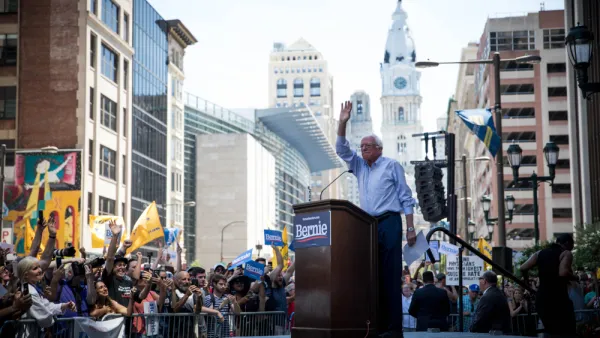
Scrutinizing the Reality of Bernie's Energy and Climate Plans
CNN host Fareed Zakaria questions whether the goals of Sanders' ambitious Green New Deal are realistic.
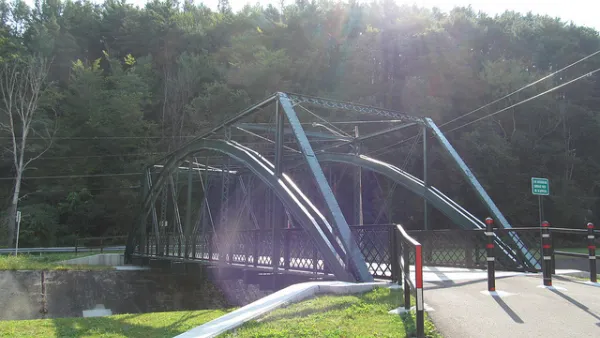
Allegheny River Town Debates Fracking Water Treatment Plant
Opponents cite environmental risks, supporters hope the facility will boost the economy of a struggling community.
Methane Emissions Replace CO2 Emissions— Is This Progress?
For the first time, electricity generated from burning natural gas will surpass coal, largely due to fracking of shale. While that means that carbon dioxide emissions will continue to drop, it also means that methane emissions will increase.

Planetizen Federal Action Tracker
A weekly monitor of how Trump’s orders and actions are impacting planners and planning in America.

‘Going backwards:’ Baltimore mayor, students rally against state's transit funding plan
Maryland's proposed six-year plan provides no funding for Baltimore’s BMORE bus program and reduces its road maintenance funding.

Detroit to transform waterfront with $2.2 billion investment
Developers will convert about 18 acres of unused parking lot space into civic spaces.

U.S.-Iran war may have ‘devastating’ impact on cost to warm homes
Vermont and Maine residents may see a 76% increase in the cost of warming their homes this winter.

Senate bill would ‘overhaul’ environmental permitting laws
Under the proposed act, government agencies would also not be able to suspend or rescind permits after granting them.

Exemption applications for NYC’s pied-à-terre tax see 55% success rate
The city sent nearly 40% of its initial pied-à-terre tax warnings erroneously.

FREE Course: Walkable City 1: Why Walkability?
After describing his path towards focusing on walkability as the essence of good planning, Jeff Speck marches through his five principal reasons for making more walkable places.
Reinventing Malls: Planning Alchemy—Turning Gray Fields Into Gold
The course focuses on the opportunities and imperatives that shape reinvention of mall sites.

One Hundred Miles
County of Mendocino
planning NEXT
The Architects Foundation
University of Cincinnati Online
Montrose County
Northern Illinois Transit Authority (NITA)
The Pocatello Development Authority