The formation of Chinatowns in the United States began in the late 19th Century, and since then have provided an important immigrant gateway. But gentrification and rising expenses in U.S. cities are shrinking many Chinatowns.


Aidan Lewis provides an account of the “slow decline of American Chinatowns.” Lewis begins the story in New York, but also provides evidence of the trend around the country.
“‘Chinatowns are turning into a sanitised ethnic playground for the rich to satisfy their exotic appetite for a dim sum and fortune cookie fix,’ says Andrew Leong, one of the authors of a recent report that charted gentrification in New York, Boston and Philadelphia's Chinatowns.”
Partly at fault for the decline, is the success of Chinese immigrant families, says Lewis. For instance, “[many] of those from Manhattan's Chinatown have moved to younger Chinese neighbourhoods in Flushing, Queens and Brooklyn's Sunset Park…But up to now, new arrivals in New York have always taken their place.”
The numbers make a striking case for the decline: “from 2000-2010 the share of the Asian population has fallen from 48%-45% in New York's Chinatown, 57%-46% in Boston's, and 49%-30% in Philadephia’s…”
Read the full story: The slow decline of American Chinatowns

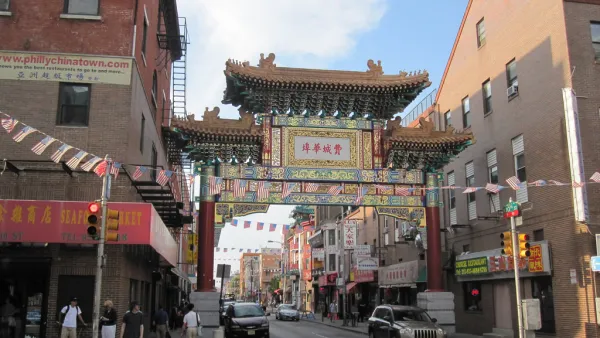
Equitable Development Plan Aims To Protect Philly's Chinatown
As the historic neighborhood experiences increased redevelopment around the new Rail Park, community activists are working to ensure older residents and businesses aren't displaced in the process.
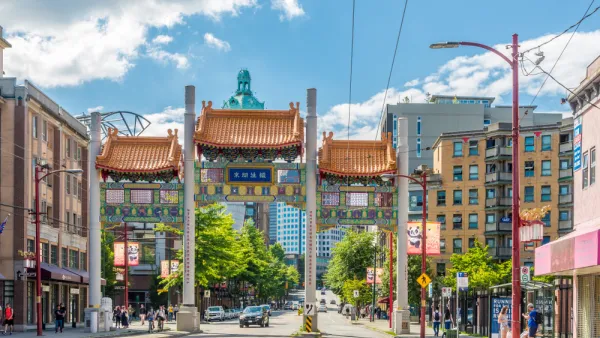
Gentrification in Chinatown Harms Social Cohesion, Food Security
A new report focuses on the consequences of gentrification in Vancouver's Chinatown neighborhood.
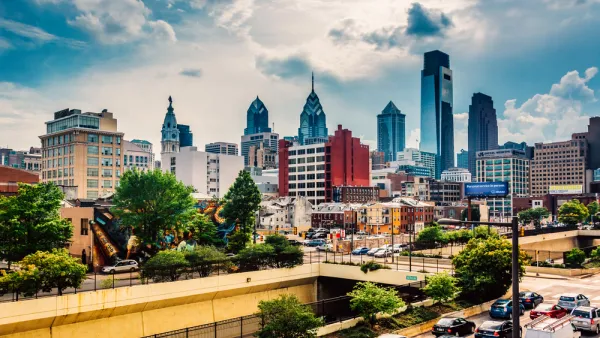
Working to Avoid the Pitfalls of the High Line
A highly anticipated linear park project in Philadelphia will open this year. Planners and activists have been working in anticipation of increased pressure on the local housing market.

Planetizen Federal Action Tracker
A weekly monitor of how Trump’s orders and actions are impacting planners and planning in America.

Amtrak, CN end decades-long dispute with eight-year agreement
The new operating agreement establishes an updated framework for the companies to work together, including processes to resolve disputes.

Judges permit Denver to divert 77,000 acre feet from the Colorado River for reservoir expansion
Overuse and climate change have caused the Colorado River’s water levels to plummet.

Atlanta City Council unanimously backs $3.5 billion Beltline light rail project
The resolution was drafted after Atlanta Mayor Andre Dickens pulled support for the Atlanta Streetcar extension last year.

SEPTA to bring nearby frequent transit to over 1 million new riders as part of decade-long plan
The agency's Accelerate plan will also bring frequent transit to twice the amount of jobs that are currently located near it.

NYC plants over 18,000 trees, the most new foliage in a decade
Many of the trees were planted in communities vulnerable to extreme heat.

FREE Course: Walkable City 1: Why Walkability?
After describing his path towards focusing on walkability as the essence of good planning, Jeff Speck marches through his five principal reasons for making more walkable places.
Reinventing Malls: Planning Alchemy—Turning Gray Fields Into Gold
The course focuses on the opportunities and imperatives that shape reinvention of mall sites.

City of Wisconsin Rapids
Harvard University Graduate School of Design
KFH Group Inc.
The Architects Foundation
University of Cincinnati Online
The Pocatello Development Authority
The Urban Renewal Agency of the City of Pocatello