The B-Cycle bike share program in Kansas City is using a crowdfunding platform to generate funds for capital investments after an underwhelming attempt to generate funds for operations.


(Updated - 01/21/2014) The bike share business model is a work in progress. While programs like Citi Bike in New York City are attracting a lot of riders, London's program lost its corporate sponsorship, and *a pilot program in Hoboken ended after a 6-month trial. Hoboken is now making a new attempt at bike share by entering into a regional partnership with Jersey City and Weehawken.
In its own bid to balance the books and deliver infrastructure improvements to the bike share system, the B-Cycle bike share program in Kansas City recently launched a crowdfunding campaign on the Neighbor.ly platform. The idea: “to run simultaneous mini-campaigns, ranging between $50,000 and $250,000, to bring anywhere from one to five stations to 10 different Kansas City neighborhoods,” writes Nancy Scola.
According to Scola, the crowdfunding campaign has multiple benefits: “to surface the sometimes-challenging mechanics of running a bike share program [and] to help create a cycling culture in a city that only three years ago was ‘a no-man’s land for bikes.’”
The current campaign is actually the second crowd funding effort by B-Cycle. The first gathered funding for the purpose of maintaining existing stations. The new campaign’s goal of building new stations was a strategic choice. “You want to have a goal you can share with an entire group of people,” says Sarah Shipley, communications director for BikeWalkKC, B-Cycle’s umbrella organization.
*The original post was updated to reflect the status of bike share in Hoboken.
Read the full story: Kansas City Tries Crowdfunding Its Bike Share

Bike-Share Spreads Across Sprawling Midwest
Bike-share is continuing its march towards world domination, with seemingly every large Midwestern American city now jumping on the bike lending bandwagon, reports Angie Schmitt.
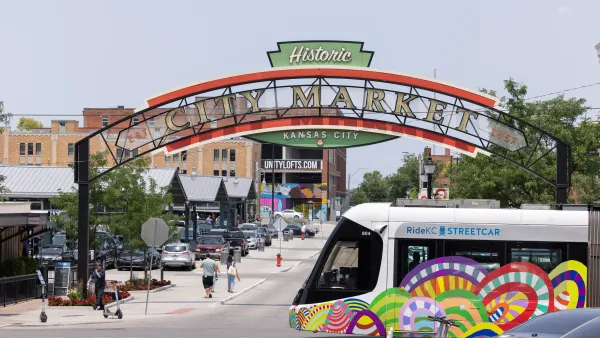
How Kansas City quietly built one of the best streetcars in America
A detailed and completely unbiased history of one of American transit's greatest comebacks.

In the 1990s, Kansas City's Womontown offered queer women community and independence
A group of women created a safe space that gave them the opportunity to buy homes and build wealth in a supportive community.

Planetizen Federal Action Tracker
A weekly monitor of how Trump’s orders and actions are impacting planners and planning in America.

‘Going backwards:’ Baltimore mayor, students rally against state's transit funding plan
Maryland's proposed six-year plan provides no funding for Baltimore’s BMORE bus program and reduces its road maintenance funding.

Detroit to transform waterfront with $2.2 billion investment
Developers will convert about 18 acres of unused parking lot space into civic spaces.

Newsom vetoes high-speed rail supervision bill after agency receives condemnatory audit
The audit found the CHSRA approved almost $600,000 in unallowable travel expenses.

Nation sees first electric plane-boat hybrid take off in public demo
The Viceroy Seaglider can fly at speeds of 180mph for up to 180 miles.

One of nation’s poorest counties to receive $6 billion data center
The developers estimate the project will create 200 permanent jobs and 1,000 temporary construction jobs.

FREE Course: Walkable City 1: Why Walkability?
After describing his path towards focusing on walkability as the essence of good planning, Jeff Speck marches through his five principal reasons for making more walkable places.
Reinventing Malls: Planning Alchemy—Turning Gray Fields Into Gold
The course focuses on the opportunities and imperatives that shape reinvention of mall sites.

City of Thousand Oaks
City of Wisconsin Rapids
Harvard University Graduate School of Design
The Architects Foundation
University of Cincinnati Online
Northern Illinois Transit Authority (NITA)
The Pocatello Development Authority
The Urban Renewal Agency of the City of Pocatello