New York's street re-designs have been praised for increasing safety and improving mobility for all users. But what effect have they had on the local economy? A new report from the city's DOT makes the business case for better streets.


"Using tax data from the New York City Department of Finance, the DOT analyzed the impact of street re-design and transportation enhancements on retail businesses. Laid out in 'The Economic Benefits of Sustainable Streets' [PDF], the data show encouraging results in seven test cases taken from three of the city's boroughs, representing a wide range of neighborhood types," reports Sarah Goodyear.
The report is a follow-up to last year's Measuring the Street report, which provided evidence of "the economic value of safety, parking, mobility and design improvements to city streets".
"Overall, the numbers revealed broad economic benefits for the streets that had been changed," notes Goodyear. "Numbers like these provide yet another powerful rational argument for street design that puts people above cars."
Read the full story: Safer Streets Pay Off for Businesses
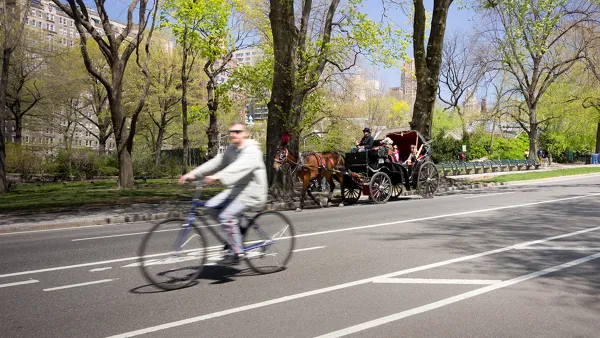
Bike Lanes a Win-Win for Cyclists and Drivers
A recent study by the New York City Department of Transportation on buffered bike lane interventions showed maintained traffic speeds while cyclist safety increased.
NYC renovations for dangerous, ‘mercilessly crammed’ street delayed until 2027
Construction was supposed to begin this fall.
NYC votes to cut outdoor dining red tape, speed up permitting
New York City also voted to allow the Department of Transportation to begin work on urgent projects before notifying elected officials.

Planetizen Federal Action Tracker
A weekly monitor of how Trump’s orders and actions are impacting planners and planning in America.

Eastern Nebraska is running out of electricity
Data centers and electrification are straining eastern Nebraska’s grid, throttling economic development.

Study reveals best places in the U.S. for cycling, walking
New research from Streetlight Data examines bicycle and pedestrian miles per capita in the 100 largest U.S. cities by population.

San Antonio is using environmental review to stall ICE detention center
San Antonio sued last month to pause work on the new detention center until the federal government studied its effect on the surrounding area.

Austin plans light rail extension — before breaking ground on light rail
The planned extension is three miles long and will take riders straight to Austin-Bergstrom International Airport.

Chicago cuts ribbon on $300,000, self-cleaning public toilet
The public toilet is the city’s first, and may pave the way for a rollout of similar facilities.

FREE Course: Walkable City 1: Why Walkability?
After describing his path towards focusing on walkability as the essence of good planning, Jeff Speck marches through his five principal reasons for making more walkable places.
Reinventing Malls: Planning Alchemy—Turning Gray Fields Into Gold
The course focuses on the opportunities and imperatives that shape reinvention of mall sites.

City of Charlotte
City of Rosemead
Rutgers University, Edward J. Bloustein School of Planning and Public Policy
University of Michigan School for Environment and Sustainability (SEAS)
Hunter College, City University of New York (CUNY)
The Architects Foundation
City of Cambridge
The Pocatello Development Authority
The Urban Renewal Agency of the City of Pocatello