Leave it up to Austin to show Texas how to reduce its auto-oriented infrastructure. A project to replace on-street parking and traffic lanes with dedicated bus and bike lanes is the result of a partnership between bike and transit planners.


"When Capital Metro, Austin's transit agency, lined up a long-awaited plan to put dedicated bus lanes on Guadalupe and Lavaca, bike planners at the city saw something else: a chance to use Austin's political support for good transit to mend a broken link in the city's bike network," writes Michael Andersen. "Transit planners, meanwhile, saw a valuable ally for one of their own goals: removing the lane of paid auto parking that ran between the dedicated bus lane and the sidewalk, blocking bus loadings and slowing transit travel times in each direction."
"The result is under construction now: not only are two 11-foot traffic lanes turning into the first dedicated bus lanes in central Texas, but the 8-foot parking lanes will be two of the state's most useful buffered bike lanes."
Read the full story: IN AUSTIN, A BUS-BIKE ALLIANCE PAYS OFF
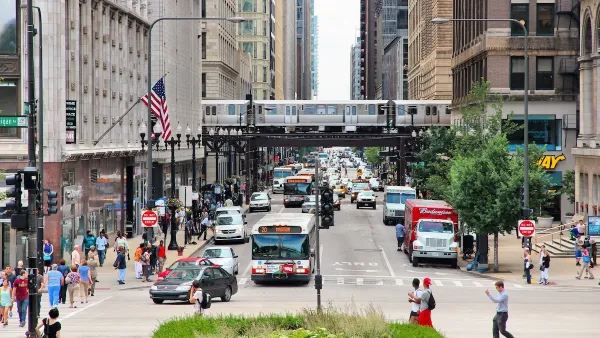
Chicago city vehicles are on the hunt for illegally-parked cars
Cameras on the vehicles can automatically issue tickets to drivers who park their cars in bus or bike lanes.
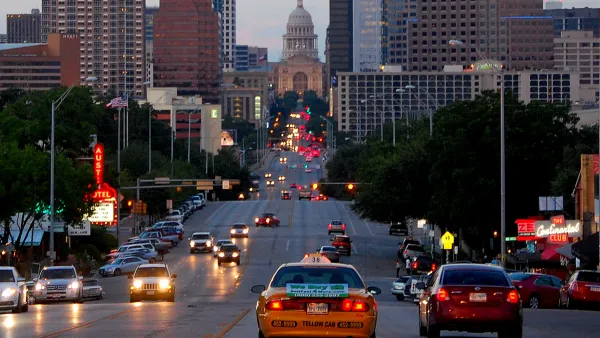
'Texas' Main Street' gets a multimodal glow-up
Congress Avenue in Austin is undergoing a major renovation to receive bike lanes and upgraded pedestrian infrastructure.
Opinion: Make Austin's Accidental Scooter Lane Permanent
Austin scooter traffic is rising, so why not make room for them?

Planetizen Federal Action Tracker
A weekly monitor of how Trump’s orders and actions are impacting planners and planning in America.

Eastern Nebraska is running out of electricity
Data centers and electrification are straining eastern Nebraska’s grid, throttling economic development.

Study reveals best places in the U.S. for cycling, walking
New research from Streetlight Data examines bicycle and pedestrian miles per capita in the 100 largest U.S. cities by population.

Federal government nominates new FTA administrator
Mark Aesch is currently the founder and CEO of a transportation management consulting firm.

Developers reveal $10 billion stadium plan as ‘Hail Mary’ to keep Bears in Chicago
The plan would also boast a public park, high- and mid-rise buildings and a youth sports complex.

As Texas embraces carbon storage, a Black community questions the risks
Texas now issues permits for companies to store carbon dioxide underground. East Texas residents fear safety risks, and skeptics doubt the climate benefits.

FREE Course: Walkable City 1: Why Walkability?
After describing his path towards focusing on walkability as the essence of good planning, Jeff Speck marches through his five principal reasons for making more walkable places.
Reinventing Malls: Planning Alchemy—Turning Gray Fields Into Gold
The course focuses on the opportunities and imperatives that shape reinvention of mall sites.

City of Charlotte
City of Rosemead
Rutgers University, Edward J. Bloustein School of Planning and Public Policy
University of Michigan School for Environment and Sustainability (SEAS)
Hunter College, City University of New York (CUNY)
The Architects Foundation
City of Cambridge
The Pocatello Development Authority
The Urban Renewal Agency of the City of Pocatello