Since it announced a plan to combat foreclosures by using eminent domain, Richmond, CA has been beset by opposition from Wall Street and Washington. Despite the threats, other cities are exploring using the controversial tool.


Wall Street, real estate interests, the Federal Housing Finance Agency, and members of Congress have been applying "intense pressure" to try to head off a plan by Richmond, CA to use eminent domain to keep its residents in their homes.
"Still," writes Shaila Dewan, "cities hard hit by the housing crash are showing interest [in using the tool]. Yonkers, just north of New York City, will soon take up a resolution to study the use of eminent domain to reduce debt, and support is building in Newark as well. In California, Pomona and Oakland are moving forward."
“'Things seem to be picking up steam in Minnesota, and I’ve just been contacted in the past couple of weeks by two cities in Pennsylvania as well,' said Robert Hockett, a Cornell University law professor and one of the architects of the strategy. Nationally, housing prices have begun to recover, but about one in five homeowners still owes more than the home is worth, and in cities like Richmond as many as half do."
Read the full story: More Cities Consider Using Eminent Domain to Halt Foreclosures
Using Eminent Domain to Keep People in Place
Richmond, California is prepared to become the first city in the U.S. to use eminent domain, a power traditionally utilized to force owners to vacate their land in the name of the public good, for the purposes of stopping foreclosures.

A 3D concrete printer may solve Virginia’s housing crisis
The printer is able to build concrete walls much faster than humans, and can do so directly at job sites.
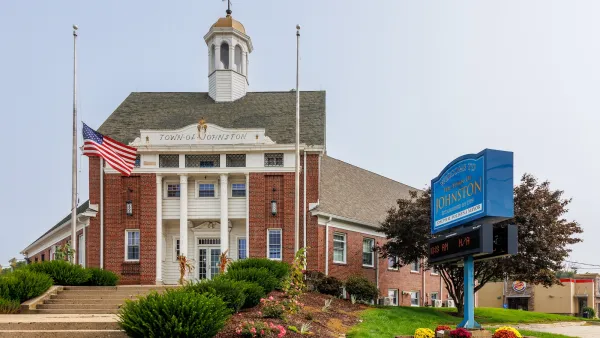
Judge says Rhode Island town can't seize private lot to block affordable housing
The town of Johnston moved to seize a lot for municipal buildings after its owners submitted a plan for a 254-unit housing development.

Planetizen Federal Action Tracker
A weekly monitor of how Trump’s orders and actions are impacting planners and planning in America.

Eastern Nebraska is running out of electricity
Data centers and electrification are straining eastern Nebraska’s grid, throttling economic development.

Study reveals best places in the U.S. for cycling, walking
New research from Streetlight Data examines bicycle and pedestrian miles per capita in the 100 largest U.S. cities by population.

DSA members accuse Mamdani of 'abandoning values' over housing redevelopment
New York City's mayor plans to replace about 2,000 units of public housing with private, mixed-income housing.

All sides of BRT debate unhappy with CDOT’s most recent move
The Colorado Department of Transportation is no longer considering center-running bus lanes for Colorado Boulevard.

Massachusetts bogs generate both power, and cranberries
Putting solar panels above farmland is one way Massachusetts is advancing toward its goal of net-zero carbon emissions by 2050.

FREE Course: Walkable City 1: Why Walkability?
After describing his path towards focusing on walkability as the essence of good planning, Jeff Speck marches through his five principal reasons for making more walkable places.
Reinventing Malls: Planning Alchemy—Turning Gray Fields Into Gold
The course focuses on the opportunities and imperatives that shape reinvention of mall sites.

City of Rosemead
Rutgers University, Edward J. Bloustein School of Planning and Public Policy
One Hundred Miles
University of Michigan School for Environment and Sustainability (SEAS)
Hunter College, City University of New York (CUNY)
The Architects Foundation
City of Cambridge
The Pocatello Development Authority
The Urban Renewal Agency of the City of Pocatello